Building on the themes of interactivity and customization that I explored in Galileo’s Virtual Library, I worked with a DCS-Computer Science major, Yassine Khayati ’25, in Spring 2025 to explore different options for visualizing the collection of books and manuscripts associated with Galileo and his family. The result is “Galileo’s Library,” a dynamic visualization that responds to users’ filters and searches. The site was meant to be a prototype for the visualizations that could complement the forthcoming book, and a way to make a research tool for the collection. Before creating the visualizations that can be found at the links below, the main entry point for the data is a search bar linked to a data set maintained by the Museo Galileo. Advanced search options are limited to name, title, or subject. That empty search bar is a perplexing thing for someone new to a digital resource. It is a door to a data set. If I am curious about what the overall collection represents, but I do not already know specific authors, topics, or titles, how do I enter? Since (digital) humanists capitalize on contextualization, are keen observers of patterns and outliers, and excel at creating focused sets of documents to analyze and compare, I wanted a tool that first emphasized attributes and features, similarly to Galileo’s Virtual Library.
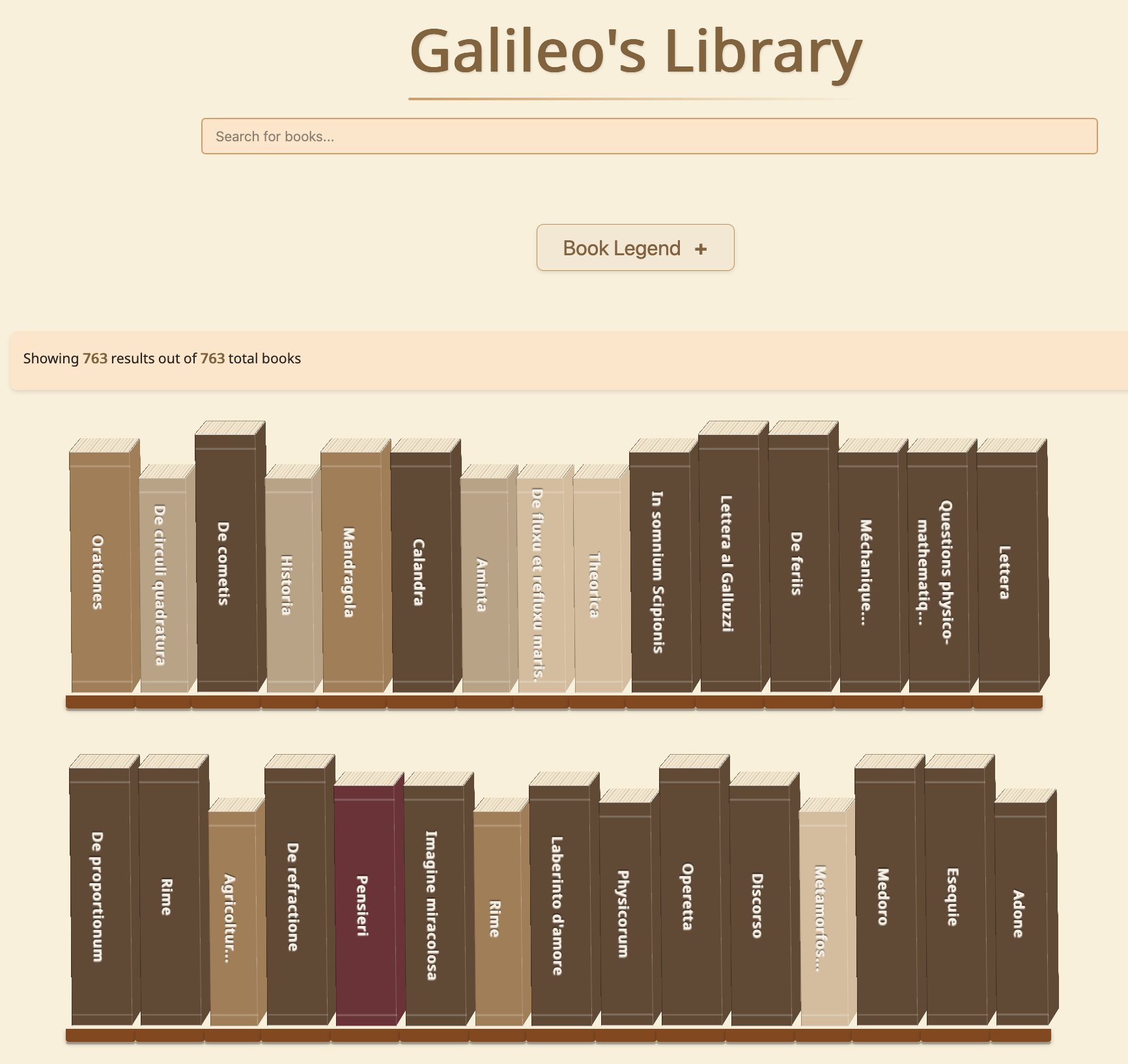
Landing page of the prototype for an interactive version of Galileo’s library
In my work with Yassine, there is still a search bar, but the default settings immediately use color and size to convey information about the collection. Even if a site visitor knows very little about Italian culture ca. 1550-1650, the purple icon for Alessandro Tassoni’s Pensieri (thoughts) stands out. (The color indicates that it is a multi-volume work.) Other color or size groupings might prompt questions about what the books have in common. A final iteration might let visitors choose what color and size represent. (This would also prevent the common equivalence of format with size, which, admittedly, is used here for differentiation.)

The legend for book icons used in the interactive visualization for Galileo’s library
Filters for attributes are immediately accessible via a menu of options on the right side of the screen. Filter options include not just the metadata for the books, but the historical data about how the books are connected to Galileo. (Note: at the bottom of the filter options the “Palatine collection” is the manuscript of Vincenzo Viviani’s library, Ms. Palat. 1195 at the Biblioteca Nazionale Centrale di Firenze.)
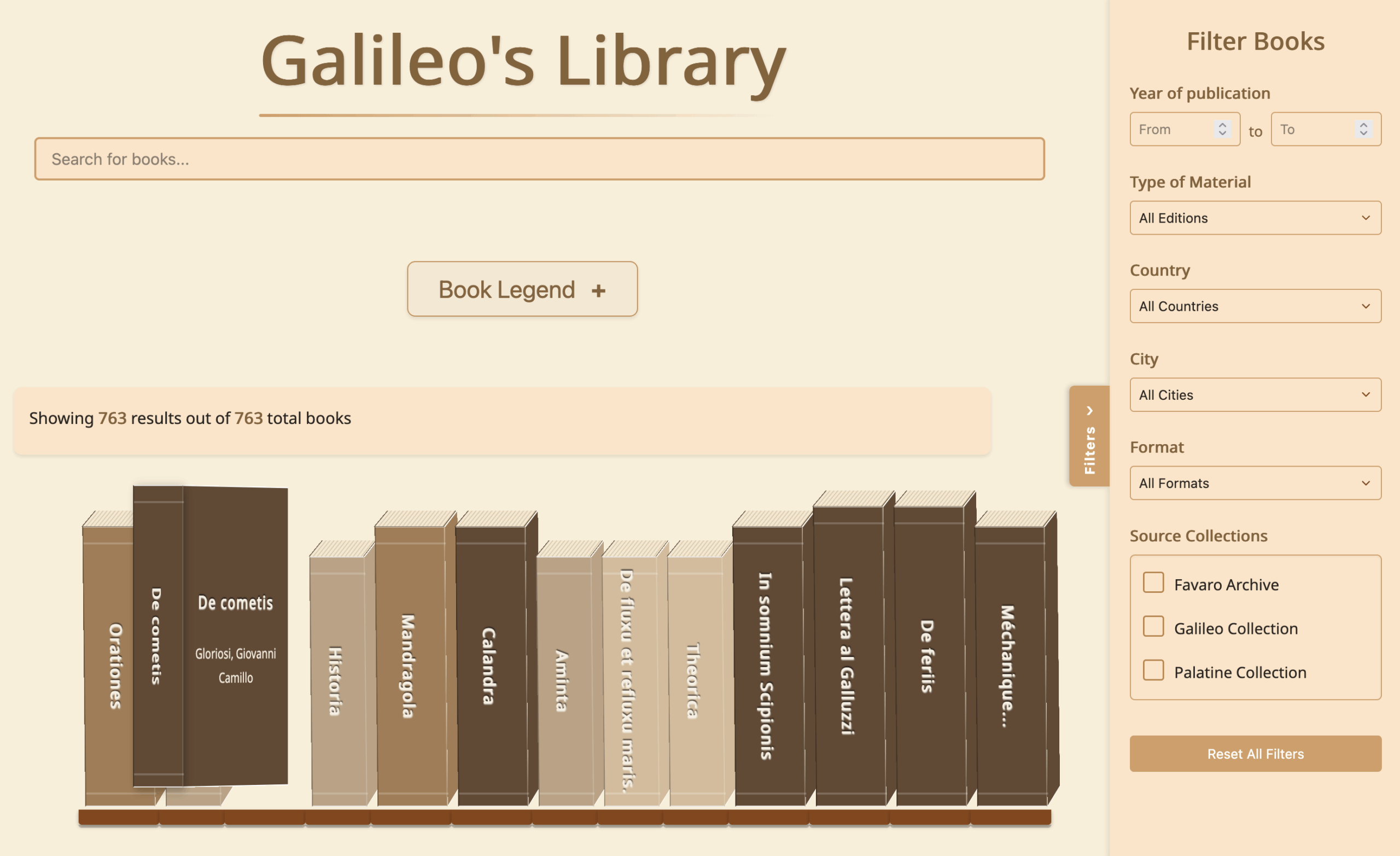
Filter menus (right) for the interactive visualization of Galileo’s Library
Hovering over a book pulls it off the shelf. Clicking on it opens an information card with more detail, all of which is found in a spreadsheet with dozens of columns. The underlying data for the site exists in a Google Sheet. This allows API queries to it from the website when filters are applied.
With the prototype live, I now have a proof-of-concept to help guide the development of a more sustainable solution. We ended the project brainstorming about two things: where further documentation is necessary and how to expand the search functionality across a multilingual data set. In an ideal circumstance, a student could reach the site and search in English for “cosmos” and see results from Latin, Italian, and French texts. My RAG research with large language models is also evaluating the extent to which an LLM interpretative layer could facilitate an even more expansive set of queries like “Italian plays.”
I am grateful to Bowdoin’s Faculty Development Committee for the grant to support Yassine’s work.
From here:
- Explore The Virtual Library
- Explore Visualizing Galileo’s The Assayer
- Explore the GaLiLeO suite of tools
- Explore the use of Large Language Models for this research