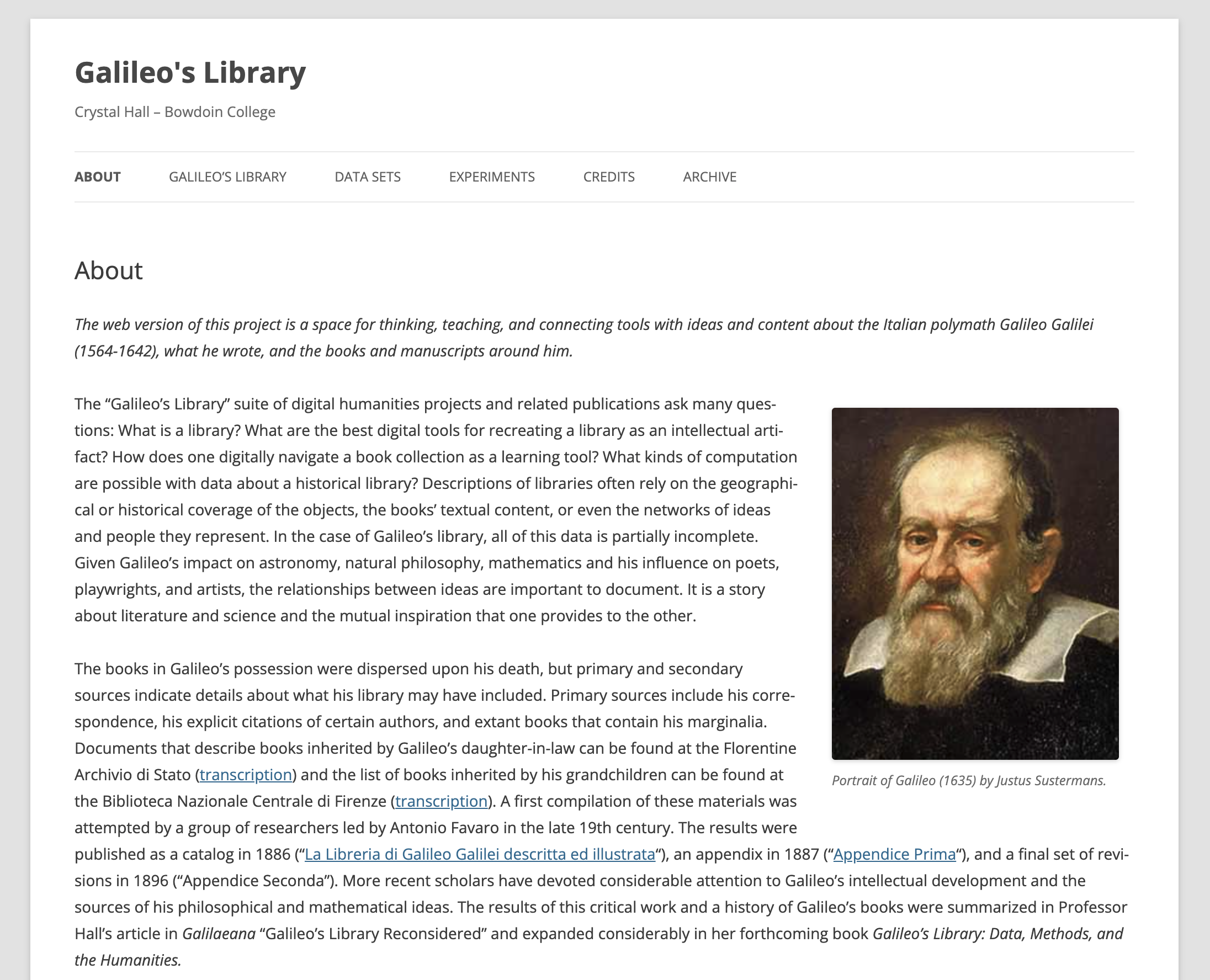
 Professor Crystal Hall’s “Galileo’s Library” suite of digital humanities projects and related publications ask many questions: What is a library? What are the best digital tools for recreating a library as an intellectual artifact? How does one digitally navigate a book collection as a learning tool? What kinds of computation are possible with data about a historical library? Descriptions of libraries often rely on the geographical or historical coverage of the objects, the books’ textual content, or even the networks of ideas and people they represent. In the case of Galileo’s library, all of this data is partially incomplete. Given Galileo’s impact on astronomy, natural philosophy, mathematics and his influence on poets, playwrights, and artists, the relationships between ideas are important to document. It is a story about literature and science and the mutual inspiration that one provides to the other.