Forty Years: The History of Women at Bowdoin

A Class Project of GWS 280 - Fall 2011

  • Prehistory
  • Process
  • Curriculum
  • Athletics
  • Extracurriculars
  • Social Life & Fraternities
  • Women’s Resource Center
  • Timeline

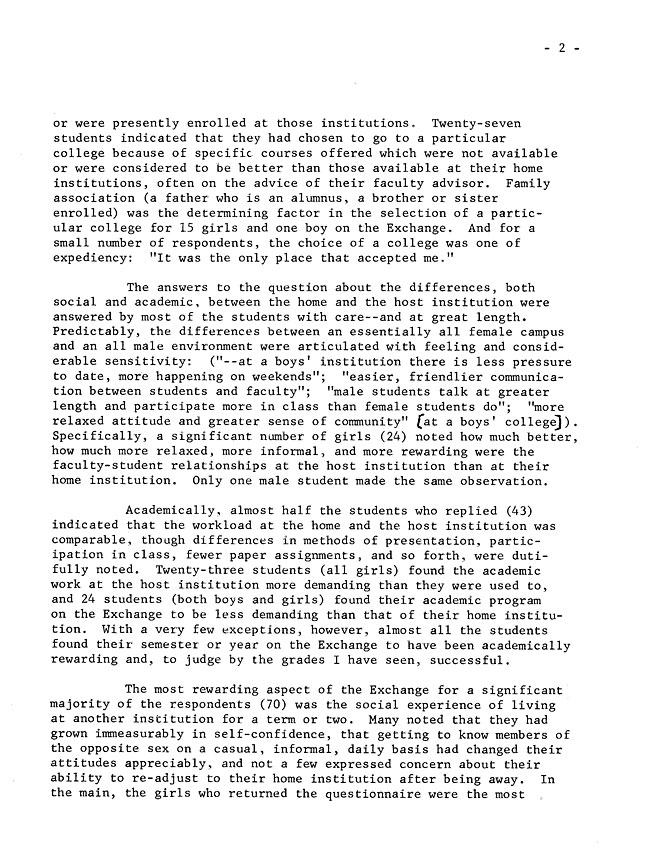
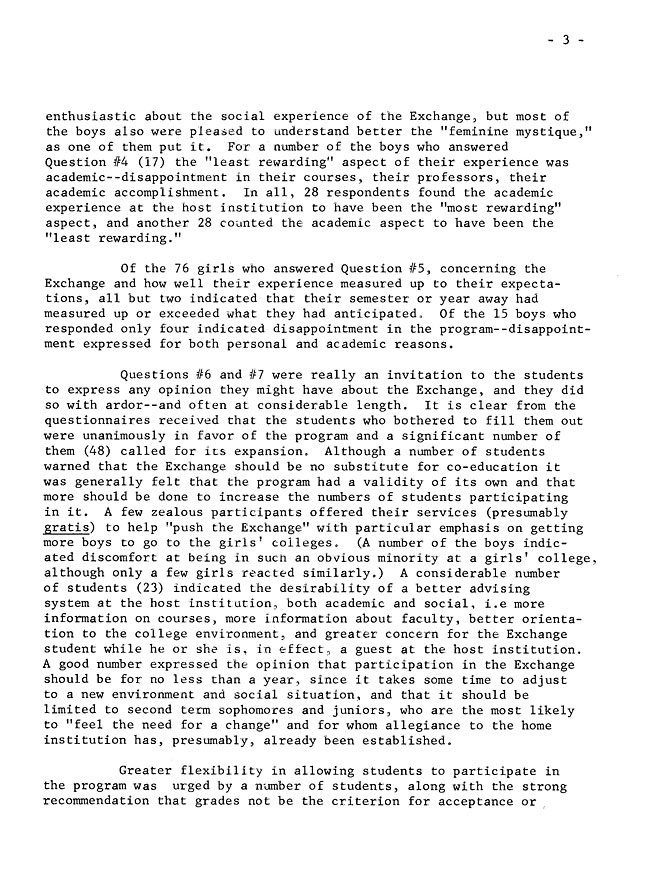
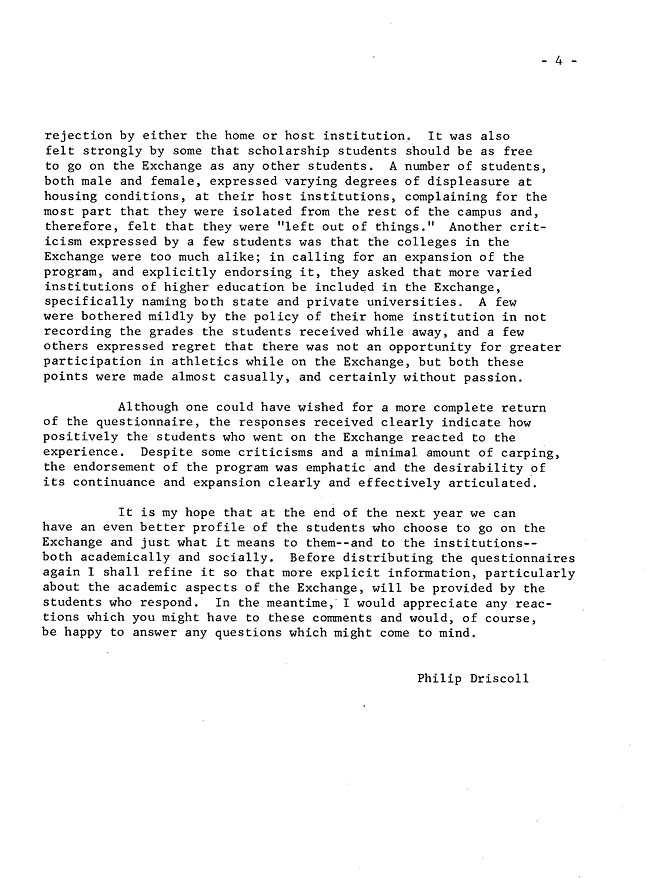
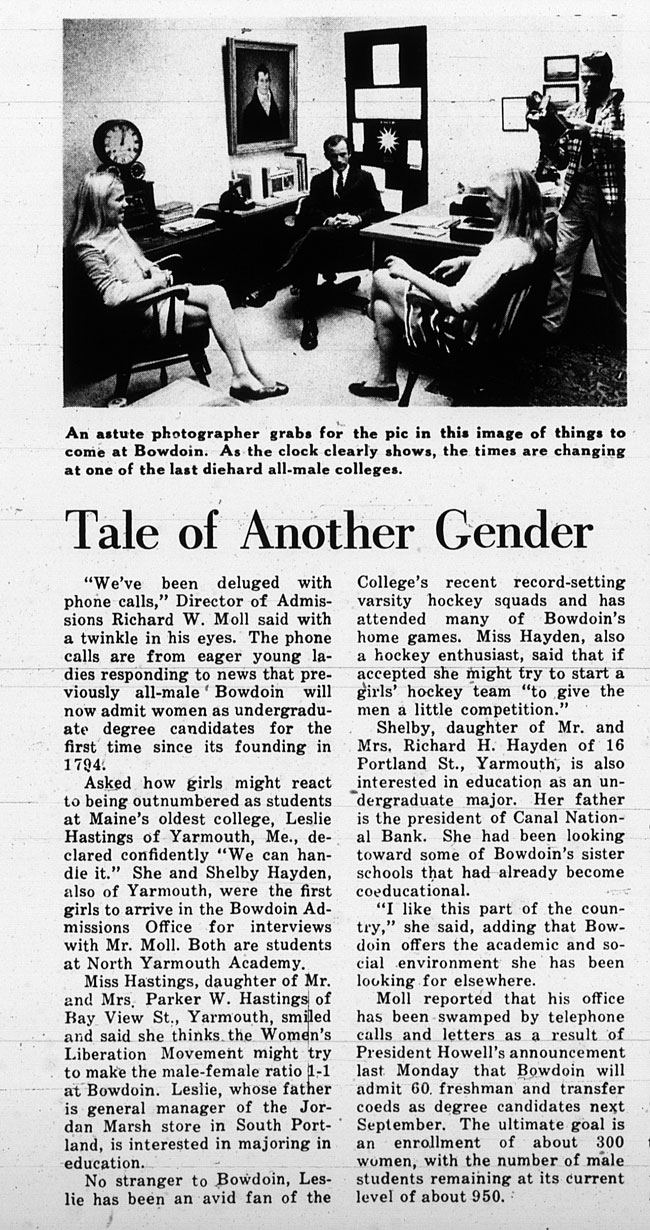
Student Twelve College Exchange Questionnaire Evaluation and Questionnaire Evaluations Summary of the first year of the Twelve College Exchange (1969-1970) – Sept. 1970

The Twelve-College Exchange was a program through which students from Amherst, Bowdoin, Connecticut College, Dartmouth, Mount Holyoke, Smith, Trinity, Vassar, Welleseley, Wesleyan, Wheaton and Williams could apply to spend a semester or year at one of the other institutions listed. It began as the “Ten-College Exchange” but was expanded within months when Trinity, then Wellesley, expressed interest in joining. The Twelve-College Exchange arose as a response to the push towards coeducation; each school was single-sex at the time and wished to experiment with coeducation without completely committing to the process.

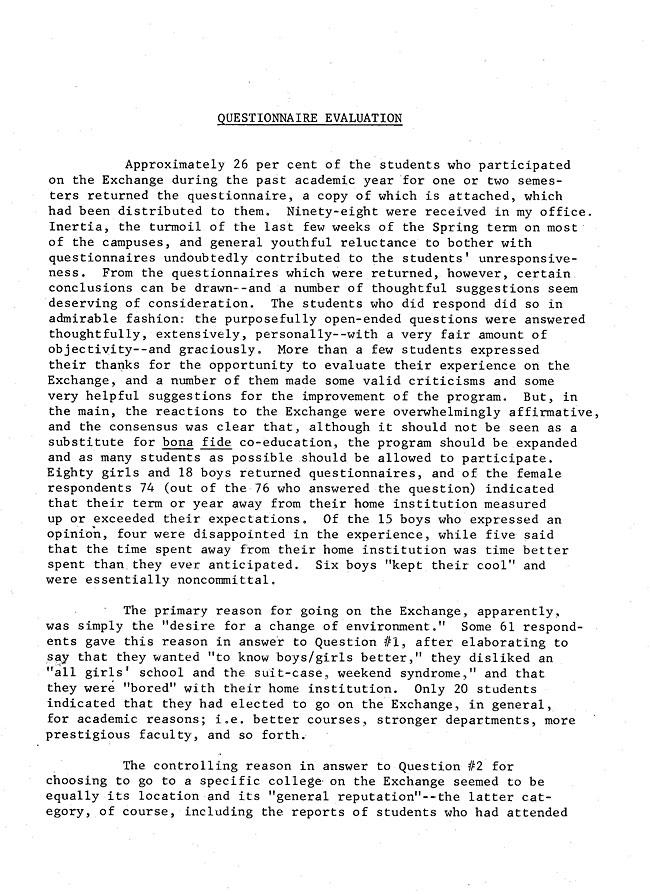
The academic year 1969-70 marked the first year of the Exchange and the first year of women students at Bowdoin. This document (Document SB, 15.1) is a student evaluation of the program. According to the Questionnaire Evaluation document (Document SB, 15.2) that summarizes the returned evaluations, approximately 26% of the students who participated the first year returned an evaluation and most of those evaluations were “overwhelmingly affirmative.” Many of the evaluations, like the selected evaluation (Document SB, 15.1), suggested the expansion of the program. This evaluation specifically described Bowdoin’s social atmosphere as “abnormal” because the nearest women were 2½ hours away. Expanding the Twelve College Exchange would increase the number of women at Bowdoin and perhaps improve this “abnormal” social atmosphere.

The student evaluations express the difference in social environment between colleges. On average, female students reported that male institutions had more “relaxed” and “friendlier” communities. Both sexes reported that one of the most significant parts of the Exchange was getting to know the opposite sex. Based on these evaluations, students from these institutions were ready and excited for coeducation. At Bowdoin, there sentiments reinforced the general feeling of staff and students that Bowdoin was ready to make the commitment.
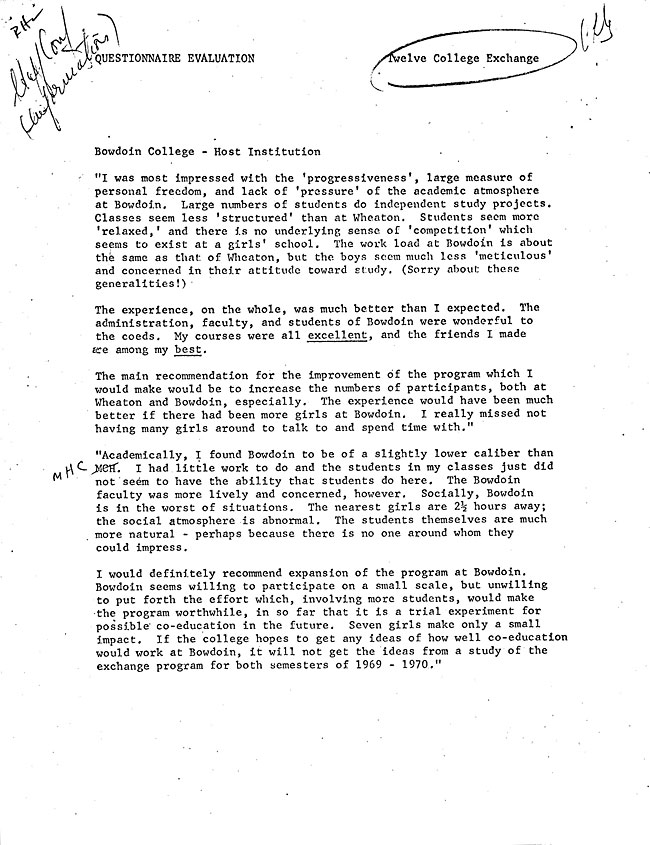
Student Twelve College Exchange Questionnaire Evaluation - sb-15.1
Questionnaire Evaluations Summary of the first year of the Twelve College Exchange(1969-1970) - Sept. 1970 -sb-15.2-page-1
Questionnaire Evaluations Summary of the first year of the Twelve College Exchange(1969-1970) - Sept. 1970 -sb-15.2-page-2
Questionnaire Evaluations Summary of the first year of the Twelve College Exchange(1969-1970) - Sept. 1970 -sb-15.2-page-3
Questionnaire Evaluations Summary of the first year of the Twelve College Exchange(1969-1970) - Sept. 1970 -sb-15.2-page-4

Filed Under: Documents, Prehistory Tagged With: Amherst, Bowdoin, Connecticut College, Dartmouth, Mount Holyoke, SB15.1, SB15.2, Smith, Trinity, Twelve College Exchange, Vassar, Welleseley, Wesleyan, Wheaton, Williams

“Tale of Another Gender” The Bowdoin Orient

On October 9, 1970, The Bowdoin Orient, Bowdoin’s student run newspaper interviewed two perspective first year students about Bowdoin College becoming coeducational.  Titled “Tale of Another Gender” (Document GB, 16) the article discusses two women’s attitudes about Bowdoin becoming coeducational.  Women were excited about the idea that Bowdoin was now admitting women students and responded confidently to issues that would arise due to being the first women admitted to this previously all-male institution.  The two women interviewed in the article, Leslie Hastings and Shelby Hayden, are fans of this new coeducation and fans of Bowdoin as a whole.

Other colleges like Bowdoin were also pondering the question of becoming coeducational.  Williams College and Rutgers University both began admitting women in 1971, and Dartmouth followed shortly after in 1972.  Universities and colleges, along with Bowdoin were slowly beginning to make the change to becoming coeducational.

The picture above the article shows the image of changing times a Bowdoin, with women now applying for admission.

GB16 - "Tale of Another Gender" The Bowdoin Orient

Filed Under: Documents, Prehistory Tagged With: 1970, GB16, Orient

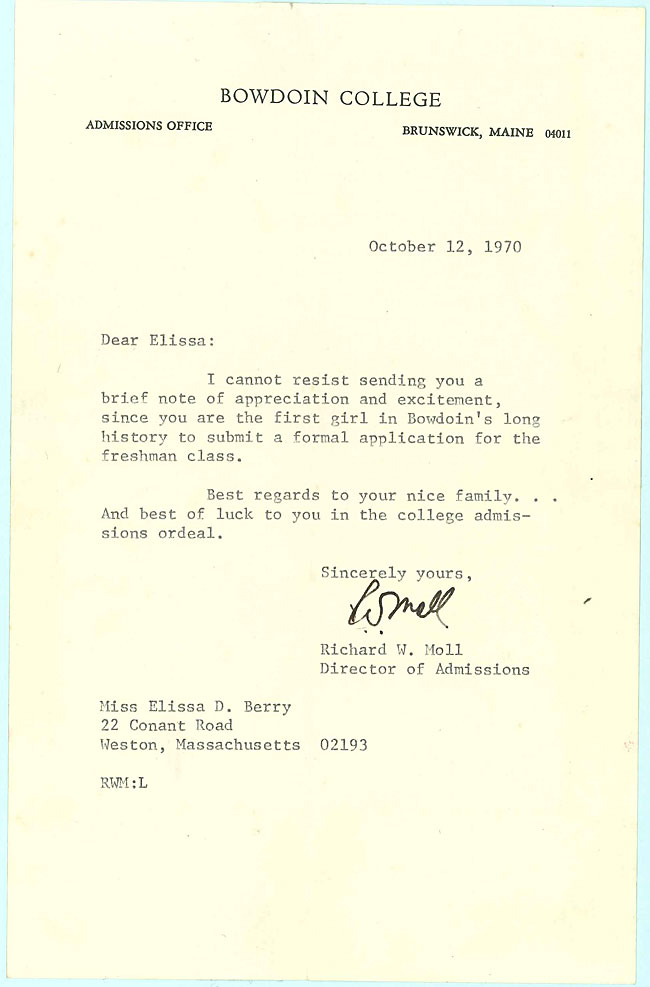
Letter from Richard Moll to Liddy Berry

This letter (Document 17, SB), from the Director of Admissions, Richard [Dick] Moll, to Elissa [Liddy] Berry, marks receipt of the first formal application from a female in Bowdoin’s history. Bowdoin matriculated its first class of women in the fall of 1971. There had been female students at Bowdoin as early as 1969 as part of the Twelve-College Exchange, but they stayed at most one year. Elissa Berry was one of the first women to spend four years as a Bowdoin student, graduating in 1975.

Berry came from a long line of Bowdoin grads: from a young age, she had set her sights on Bowdoin. There was only one problem; Bowdoin was an all-male institution. This did not deter Berry who planned to study at Bowdoin by any means necessary, and who considered applying to a Twelve-College Exchange institution so she could apply for a semester at Bowdoin. During the fall of 1970, Bowdoin announced that it would go coed the following academic year. Once Berry heard the news, she had her application completed and submitted within the week.

This letter reveals the excitement surrounding coeducation at Bowdoin. Berry was one of 147 women on Bowdoin’s campus during the 1971-1972 academic year. These courageous women served as the trailblazers for future Bowdoin women. Their enthusiasm overshadowed the potential risks of being in a significant minority. Like the applicants, Bowdoin staff members were also excited about coeducation. Richard Moll’s words in this letter affirm this as he describes the “appreciation and excitement” felt on campus.

Letter from Richard Moll to Liddy Berry -sb-17

SB 17

Filed Under: Documents, Prehistory Tagged With: 1970, Elissa Berry, Letter, Liddy Berry, Richard Moll, SB17, Twelve College Exchange

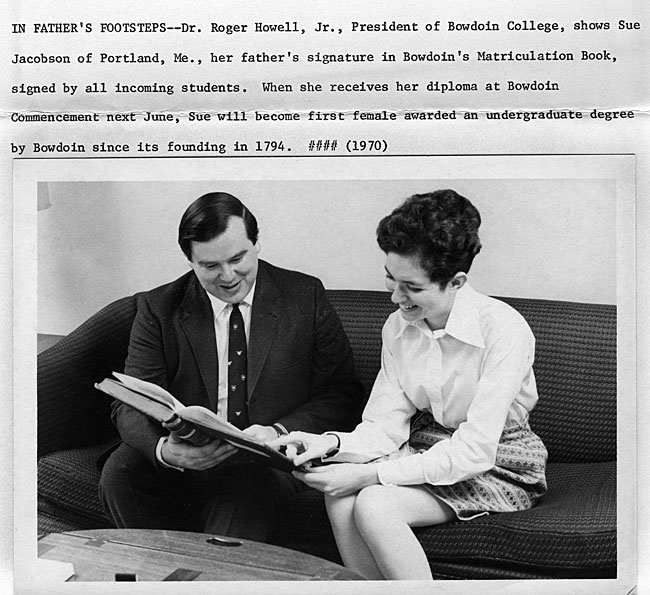
In Father’s Footsteps – Sue Jacobson and President Howell

Susan Jacobson, Bowdoin’s first college graduate, is pictured sitting next to President Dr. Roger Howell peering at her father’s signature in Bowdoin’s famous matriculation book (Document 18, GB).  Jacobson, who recently passed away on October 4, 2011 graduated magna cum laude with a degree in English, then pursued a masters in library science at Simmons. She then worked at Yale and Youngstown State University as an acquisition librarian.

Native of Portland, Jacobson attended Bowdoin through the Twelve College Exchange Program and eventually transferred to Bowdoin from Connecticut College.  Along with her interest in the small but highly touted English department at Bowdoin, Jacobson also wanted to attend the same college her father enjoyed during his undergraduate years.  The administration of Bowdoin allowed alumni’s daughters a chance to attend Bowdoin helped the college transition to coeducation.  Alumni would be in favor of coeducation because it was giving their daughters an opportunity to their alma mater.

Jacobson’s signature proudly holds its place as one of the first female names in this matriculation book.  The tradition of signing the matriculation book at Bowdoin still holds firm where students meet briefly with the President of Bowdoin before signing the famous book themselves.  Students have a brief one on one conversation with the President and are then invited to sign the book to become a part of Bowdoin’s history.  The signing now takes place during orientation for freshman every fall.

GB18 - In Father's Footsteps - Sue Jacobson and President Howell

Filed Under: Documents, Prehistory Tagged With: GB18, Jacobson, Photo, President Howell, Susan Jacobson

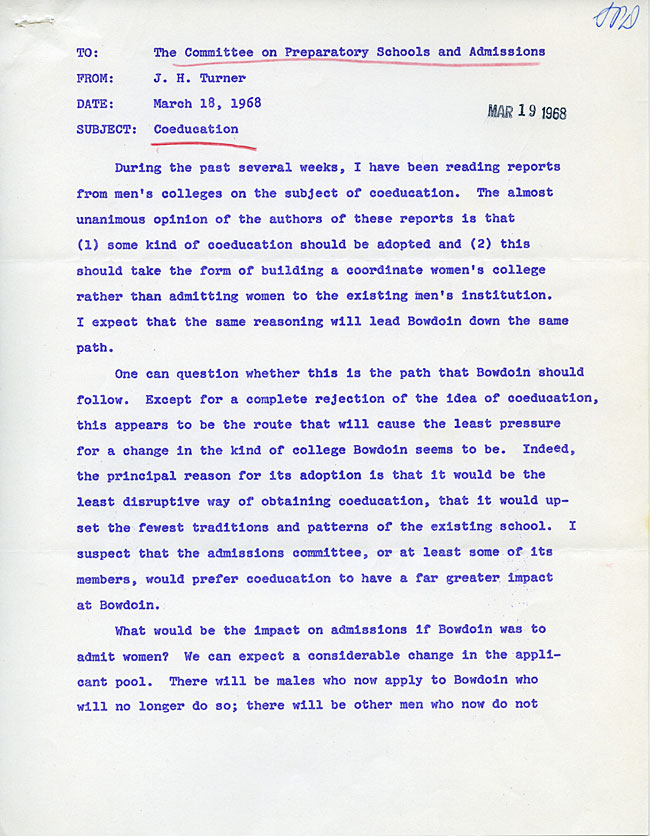
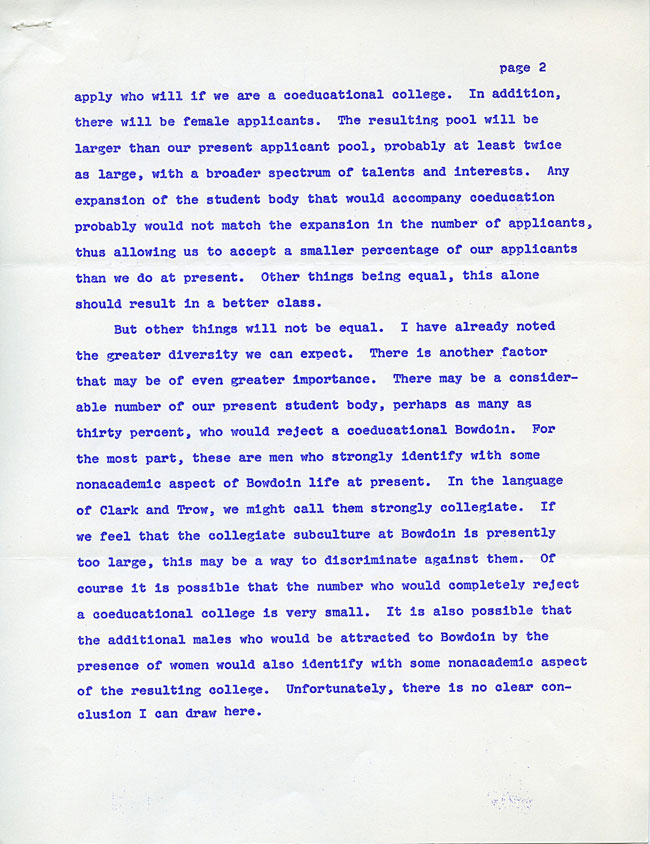
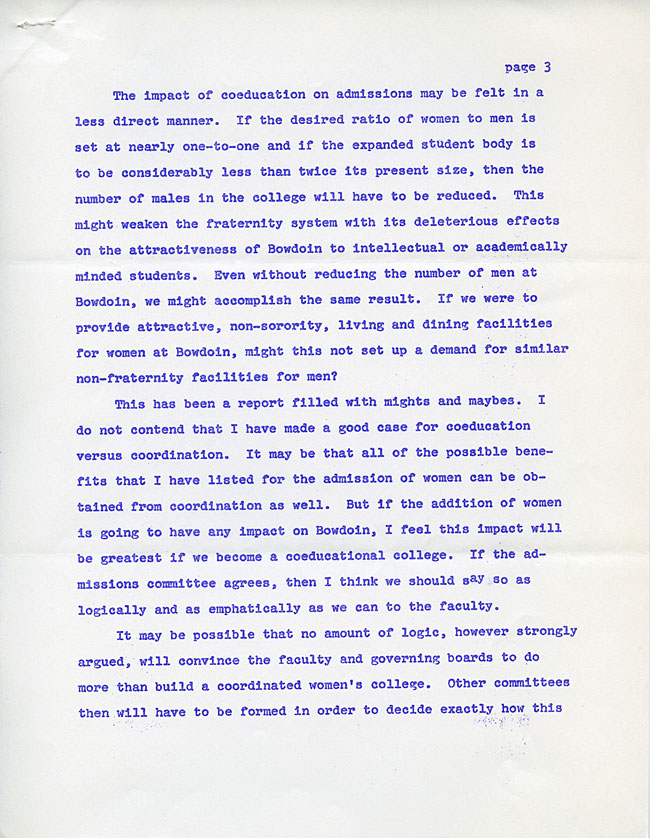
Coeducation versus Coordination: Thoughts from Professor J.H. Turner

In this letter (Document EN, 19), Professor of physics James H. Turner makes an argument for coeducation at Bowdoin. Written approximately two and a half years before the College made the decision to become coeducational, and three and a half years before the first class with women arrived at Bowdoin, Turner reflects on the possible effects of having women matriculate at the College.

Turner notes that many colleges at the time were turning to coordination (building a separate but related women’s college) rather than full coeducation. For example, Harvard had recently developed a coordinate relationship with Radcliffe College, one that would continue until 1999, when Harvard finally became fully coeducational. Turner argues, however, that Bowdoin would see a “far greater impact” from coeducation if it admitted women rather than built a coordinate college.

Regarding admissions, Turner suggests that coeducation will cause a much larger applicant pool that will have a “broader spectrum of talents and interests” and “result in a better class.” In fact, Marcia Synnott in Going Coed claims that the admission of women at Princeton in 1969 “raised the academic caliber of freshmen” (123). Turner also argues that bringing women to Bowdoin might result in a more academic college, because the men who will reject coeducation are likely the ones who “strongly identify with some nonacademic aspect of Bowdoin life at present.” Although Turner admits that his ideas are largely speculative and the advantages he raises might also be true of coordination, he remains an ardent supporter of coeducation because he would like to see the addition of women have a strong impact on the College.

EN19a - Coeducation versus Coordination: Thoughts from Professor J.H. Turner
EN19b - Coeducation versus Coordination: Thoughts from Professor J.H. Turner
EN19c - Coeducation versus Coordination: Thoughts from Professor J.H. Turner
EN19d - Coeducation versus Coordination: Thoughts from Professor J.H. Turner

Filed Under: Documents, Process Tagged With: EN19, Letter, Professor J.H. Turner

  • « Previous Page
  • 1
  • …
  • 9
  • 10
  • 11
  • 12
  • 13
  • …
  • 17
  • Next Page »

Categories

  • Athletics (9)
    • Documents (6)
    • Focus Group (1)
    • Oral History Interview (2)
  • Curriculum (8)
    • Documents (6)
    • Focus Group (1)
    • Oral History Interview (1)
  • Extracurriculars (10)
    • Documents (6)
    • Oral History Interview (3)
  • Prehistory (20)
    • Documents (18)
    • Oral History Interview (2)
  • Process (22)
    • Documents (12)
    • Focus Group (3)
    • Oral History Interview (7)
  • Social Life & Fraternities (20)
    • Documents (12)
    • Focus Group (3)
    • Oral History Interview (5)
  • Women’s Resource Center (8)
    • Documents (6)
    • Focus Group (1)
    • Oral History Interview (1)
  • Sources
  • Acknowledgments

Copyright © 2026 · research.bowdoin.edu · Powered by WordPress