Forty Years: The History of Women at Bowdoin

A Class Project of GWS 280 - Fall 2011

  • Prehistory
  • Process
  • Curriculum
  • Athletics
  • Extracurriculars
  • Social Life & Fraternities
  • Women’s Resource Center
  • Timeline

Deborah Mann Speaks at 1975 Commencement Ceremony

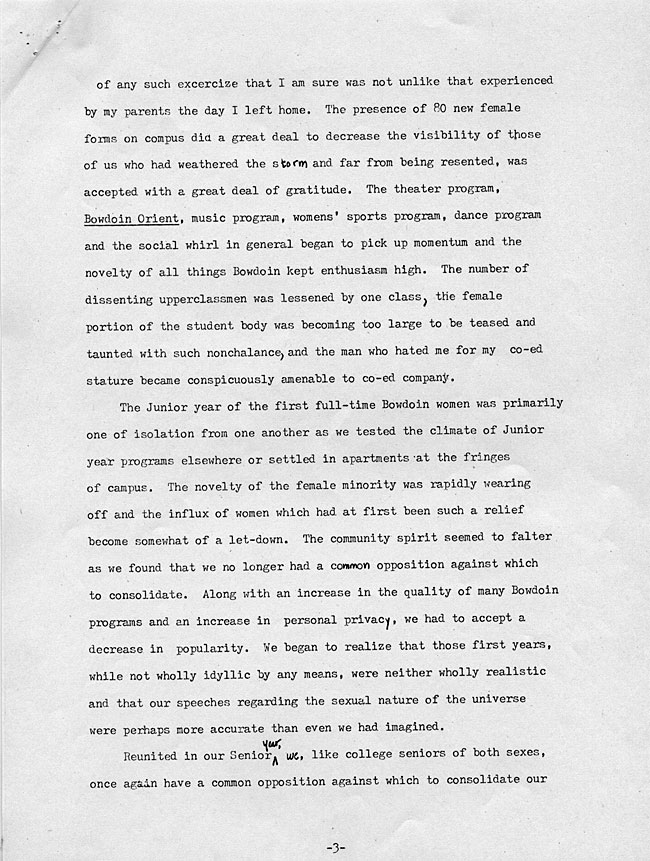
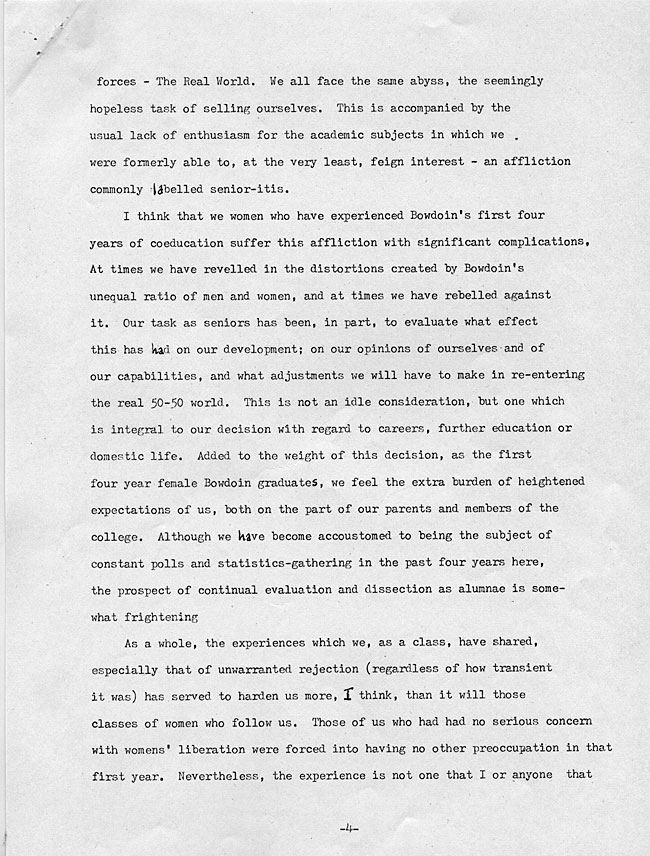
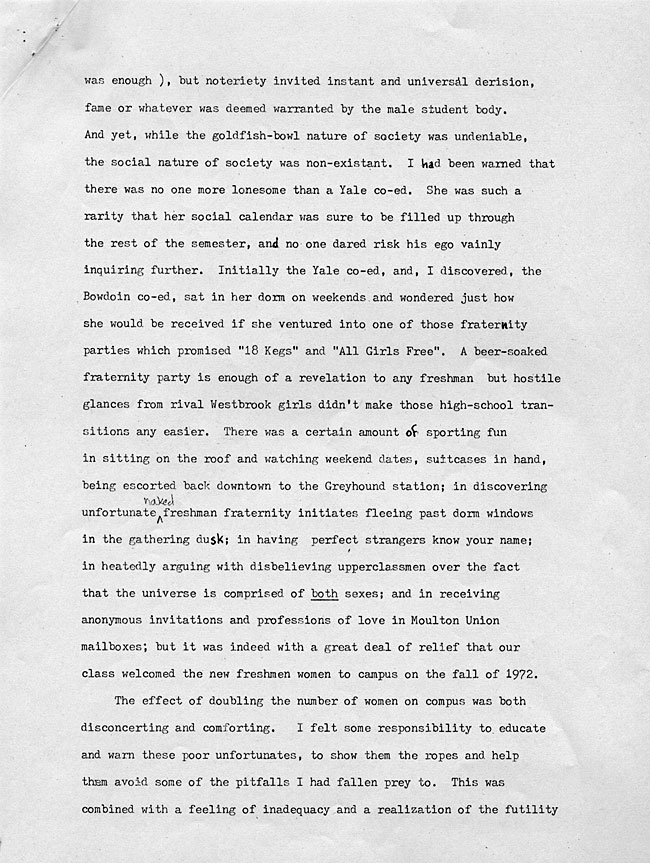
Deborah Mann’s 1975 commencement address offers a unique insight into the day-to-day experience of a Bowdoin woman in the first full graduating class (Document AK, 30). Mann describes some of the more flagrant misogyny remaining on the formerly all-male campus as well as the remarkable tenacity and courage with which this prejudice was met by these early Bowdoin women.

Mann includes an intriguing anecdote that demonstrates some of this discrimination: “An upperclassman, somewhat put out, once told me that he hoped I didn’t misunderstand – he didn’t hate me personally, he simply hated me as a co-ed.” As disturbing as this comment may seem, Mann’s real message is that, “The courage of those first cheerleaders, actresses and champions of the cause of women’s liberation cannot be overestimated.” She laments the “fish bowl” nature of the still male-controlled community at Bowdoin, claiming that “Visibility was something to be avoided […] but notoriety invited instant and universal derision, fame or whatever was deemed warranted by the male student body.” Mann also discusses the tremendous party and alcohol scene – so often cited as a partial impetus behind coeducation in the first place – plus the tenuous dynamic between Bowdoin women and women attending nearby Westbrook College who arrived on weekends to participate in social events, only to leave again each Sunday.

Gratefully, Mann eventually writes, “[…] the female portion of the student body was becoming too large to be teased and taunted with such nonchalance.” With this shift came a lessening of some female solidarity, as the common male enemy, as it were, was no longer behaving quite so terribly. Interestingly, many of the men with whom we have spoken for this project have indicated that while coeducation was important, many other issues eclipsed coeducation as the issue of the day, such as social unrest, the Vietnam war, and the growing drug culture. Mann, however, puts it differently: “Those of us who had had no serious concern with women’s liberation were forced into having no other preoccupation in that first year.”
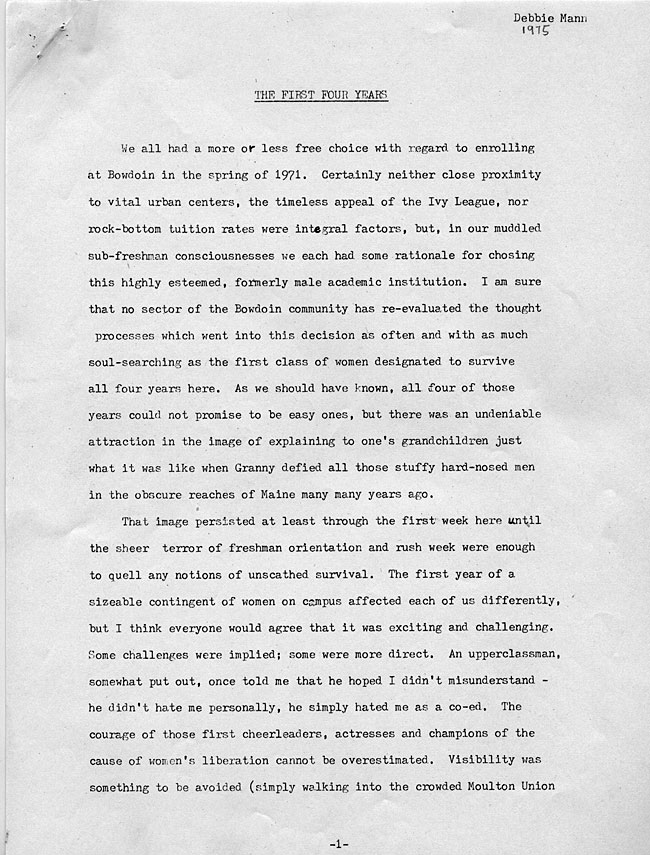
AK30a - Deborah Mann Speaks at 1975 Commencement Ceremony
AK30b - Deborah Mann Speaks at 1975 Commencement Ceremony
AK30c - Deborah Mann Speaks at 1975 Commencement Ceremony
AK30d - Deborah Mann Speaks at 1975 Commencement Ceremony
AK30e - Deborah Mann Speaks at 1975 Commencement Ceremony

Filed Under: Documents, Process Tagged With: 1975, AK30, Commencement Address, Deborah Mann

Interview with Rosalyne Spindel Bernstein, Bowdoin Overeer, by Anna Wright ’12

In the fall of 1973, Roz Bernstein was elected to Bowdoin’s Board of Overseers—the first woman to serve in that capacity in the history of the College. Her election was motivated, in part, by the College’s 1971 move to coeducation. She served on the Board for over twenty years, where she was instrumental in the decision to eliminate fraternities. Today, she remains a Board member emerita. Click the audio link below to  hear Bernstein’s reflections on her time on the Board—particularly its approach to coeducation, and the questions that she expects it to confront in the future.

Audio: click below to begin listening

http://learn.bowdoin.edu/gender-women/audio/roz-bernstein-interview.mp3

Time: 4:18

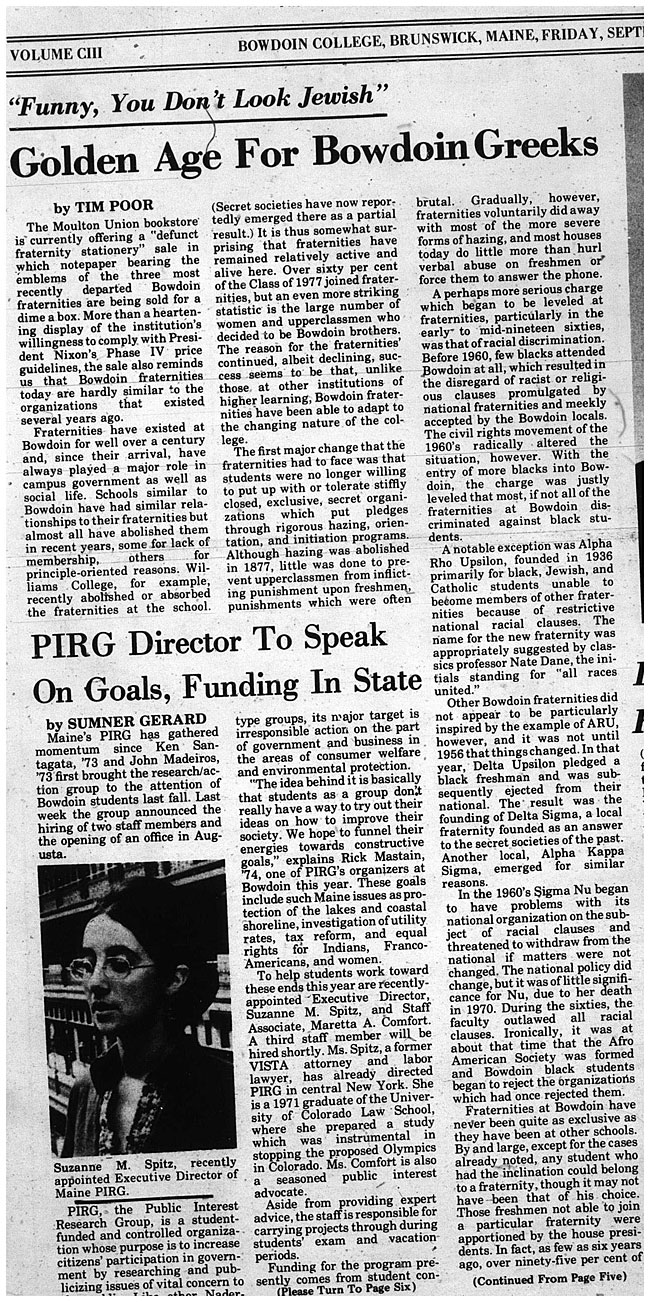
AW49-1 - Orient: Golden Age for Bowdoin Greeks

On the Board’s reaction to her appointment: “When I went to my first meeting, you know, everyone was most cordial, but one guy said to me, ‘I’m very glad to meet you, but you know, I still think women don’t belong at Bowdoin,’ and I said, ‘Well, you know, that may be your opinion, but obviously, you’re in the minority.’ ”


Time: 31:09

On alumni backlash against some of the Board’s decisions: “People have this passion about their college, which is wonderful and has to be maintained, but you know, I don’t pay much attention to the grumbling. There will always be grumblers. But that fades away over time.”


Time: 31:33

On coeducation: “It’s the best thing that ever happened to Bowdoin College…It transformed attitudes on campus; it transformed campus life; it transformed the classroom.”


Citation: I, Anna Wright, interviewed Roz Bernstein on Sunday, October 30, 2011, at her home in Portland, Maine. We discussed her experience as the first woman on the Bowdoin College Board of Overseers, particularly as it related to the College’s change from an all-male institution to a coeducational one.


Filed Under: Oral History Interview, Oral History Interview, Prehistory, Process Tagged With: 1973, Bowdoin Overseer, Interview, Overseer, Rosalyne Spindel Bernstein, Roz Bernstein

Interview with Saddie Smith ’75, by Stephanie Bond ’13

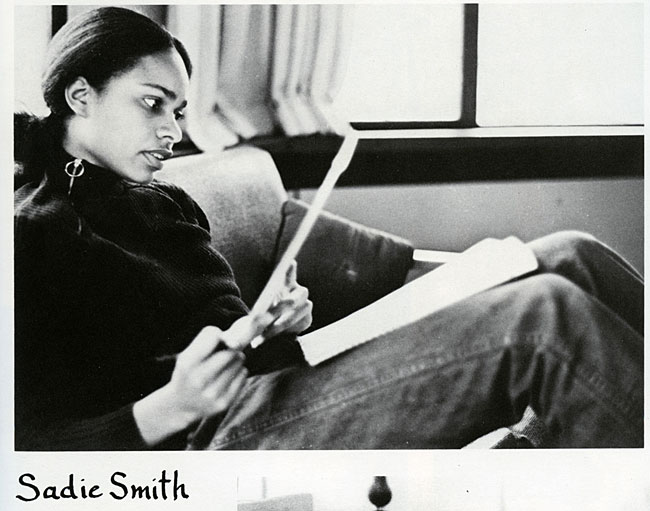
Saddie Smith ’75
Saddie Smith ’75 Yearbook Photo


 An African American Female Student Perspective on Coeducation at Bowdoin: A Discussion with Saddie Smith

 As a member of Bowdoin’s first class of admitted women, Saddie Smith had to balance being both a female and an African American student. Failure at Bowdoin was not an option for Smith, a first-generation college student, so she put her nose to the books. Smith credits Bowdoin for the confidence that led her to impressive heights, from a Sewall Latin Prize at Bowdoin, to a degree at Columbia Law School, to the influential VP position she now holds at Consolidated Edison Co. of New York, Inc. To hear Smith tell her story about how she established herself as an African American woman in the first class of women at Bowdoin, listen to the audio links below.  You will see how she uses humor to her advantage.

Audio: click tracks(s) below to begin listening

http://learn.bowdoin.edu/gender-women/audio/saddie-smith-75-interview-steph-bond-part-1.mp3 http://learn.bowdoin.edu/gender-women/audio/saddie-smith-75-interview-steph-bond-part-2.mp3 http://learn.bowdoin.edu/gender-women/audio/saddie-smith-75-interview-steph-bond-part-3.mp3

Intriguing Pieces:
Section 1-

Time: 00:21:56

Quotation: [In reference to the practice of bussing women from other schools to Bowdoin for parties] “It was a carryover, cause I was a freshman, so that’s kind of what they did. That was part of the whole social thing is bringing, I guess, busloads of women to campus and they kind of, like, forgot about—well I guess it’s kind of good because they saw us as, like, just one of the guys.”

Section 3-

Time: 00:11:32

Quotation: [In reference to difference between HBC and Bowdoin]“I think it was easier for me to fit in at Bowdoin than it would have been for me to fit in at say, Spellman, because at Bowdoin it was obvious that I was different; a woman, a minority. But in a Historically Black College I think I would have, there would have been more pressure to try to fit because I was one of them.”

Time: 00:16:00

Quotation: [In reference to being both an African American and female]“Black women, we kinda get rolled up into one or the other. Either black or either woman and we never get our little, like, standalone kind of thing and I think it’s a very different dynamic, and a dual personality, and you’re always balancing the African American verses the woman.”

Citation: I, Stephanie Bond, interviewed Saddie Smith ‘75 on Sunday, November, 20 2011, in New York, New York. We discussed how Saddie Smith’s experience as a member of the first admitted class of women at Bowdoin College was shaped by her status as both an African American and female student.


Filed Under: Extracurriculars, Oral History Interview, Oral History Interview, Oral History Interview, Process, Social Life & Fraternities Tagged With: 1975, Interview, Saddie Smith

Interview with Beth (Cantara) Richardson ’79, by Jillyan Henrikson ’12

Beth (Cantara) Richardson ’79

A Female Athlete in a Men’s Athletic World: A Discussion with Beth Richardson, ‘79

In this interview, Beth Richardson, a member of the basketball and outdoor track teams at Bowdoin from 1975-1979, discusses her time on campus as a female student-athlete during the first years of coeducation at the College. To hear Beth’s take on how the administration viewed women’s athletics, her relationship with her teammates and Coach Dick Mersereau, and the women’s basketball team’s second-class citizenship, listen below.


Audio: click tracks(s) below to begin listening

https://learn.bowdoin.edu/gender-women/audio/interview-with-beth-richardson-part-1-jill-henrikson.mp3 https://learn.bowdoin.edu/gender-women/audio/interview-with-beth-richardson-part-2-jill-henrikson.mp3 https://learn.bowdoin.edu/gender-women/audio/interview-with-beth-richardson-part-3-jill-henrikson.mp3 https://learn.bowdoin.edu/gender-women/audio/interview-with-beth-richardson-part-4-jill-henrikson.mp3

Intriguing pieces:

Time: Part 1, 00:01:35

Quotation: [In reference to bonds shared with teammates] “…so, an incredible sense of camaraderie throughout all 4 years, a sense of support, you always knew there was someone you could talk to…it was like having a bunch of sisters.”


Time: Part 1; 00:04:20

Quotation: [In reference to a comparison of the women and men’s basketball teams] “We put up with a lot. We were definitely second class citizens [in comparison to the men].”


Time: Part 4, 00:26:35

Quotation: [In reference to final comments on experiences as a female student-athlete at Bowdoin] “You know, it was kind of an interesting balance between having a group of women who you really loved and loved you, and having virtually no recognition by the College. It was really odd. You know, to be that tight and to work that hard, but not have the College see you as a serious athlete. But, we had a good time.”


Citation: I, Jill Henrikson, interviewed Beth Richardson on November 4, 2011 at her home in Portland, Maine. We discussed both Beth’s experiences as a member of the women’s basketball and outdoor track team, as well as her identification as a student-athlete on the Bowdoin campus from 1975-1979.

Filed Under: Athletics, Oral History Interview Tagged With: 1979, Basketball, Beth Richardson, Dick Mersereau, Interview, Richard Mersereau, Track

Women’s Resource Center Focus Group

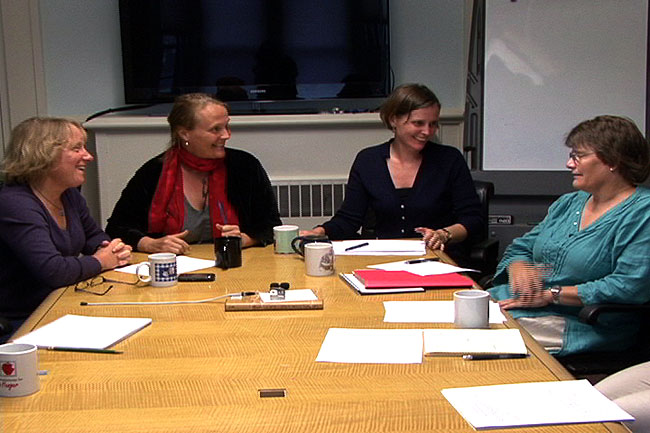
This discussion brought together four Bowdoin women who all played important roles in establishing Bowdoin’s still vibrant and active Women’s Resource Center. Jan Brackett  and Bridget Spaeth ’86 each served as directors for the WRC, and Linda Nelson ’83 and Laura Barnard ’83 were early members of the Women’s Resource Center Collective that founded the WRC in 1980. All four women share stories of triumph and love in the face of adversity and discrimination. Their discussion offers unique insight into what it was like to be a woman at Bowdoin in the late 70’s and early 80’s – the good, the bad, and the unexpected.

Audio: click title below to begin listening

https://learn.bowdoin.edu/gender-women/audio/womens-resource-center-focus-group.mp3
Women's Resource Center Focus Group

Filed Under: Extracurriculars, Focus Group, Focus Group, Social Life & Fraternities, Women’s Resource Center Tagged With: Bridget Spaeth, Focus Group, Focus Group Interview, Jan Brackett, Laura Barnard, Linda Nelson, Women's Resource Center

  • « Previous Page
  • 1
  • …
  • 12
  • 13
  • 14
  • 15
  • 16
  • 17
  • Next Page »

Categories

  • Athletics (9)
    • Documents (6)
    • Focus Group (1)
    • Oral History Interview (2)
  • Curriculum (8)
    • Documents (6)
    • Focus Group (1)
    • Oral History Interview (1)
  • Extracurriculars (10)
    • Documents (6)
    • Oral History Interview (3)
  • Prehistory (20)
    • Documents (18)
    • Oral History Interview (2)
  • Process (22)
    • Documents (12)
    • Focus Group (3)
    • Oral History Interview (7)
  • Social Life & Fraternities (20)
    • Documents (12)
    • Focus Group (3)
    • Oral History Interview (5)
  • Women’s Resource Center (8)
    • Documents (6)
    • Focus Group (1)
    • Oral History Interview (1)
  • Sources
  • Acknowledgments

Copyright © 2026 · research.bowdoin.edu · Powered by WordPress