Forty Years: The History of Women at Bowdoin

A Class Project of GWS 280 - Fall 2011

  • Prehistory
  • Process
  • Curriculum
  • Athletics
  • Extracurriculars
  • Social Life & Fraternities
  • Women’s Resource Center
  • Timeline

Bowdoin Film Society Flyer, Awards and Kaster’s Film History Class

The implementation of coeducation at Bowdoin College undoubtedly changed the social scene at the time, challenging long held fraternity traditions and practices. Coeducation also changed Bowdoin academically. The presence of women faculty at Bowdoin created new possibilities for academic pursuits. Professor Barbara Kaster came to Bowdoin with a position in the English Department. She accepted the position on the condition that she be allowed to teach Film as well. Kaster taught Film History and made filmmaking a mandatory part of the course. The Bowdoin Film Society (BFS), founded in 1974, grew out of Kaster’s Film History class.
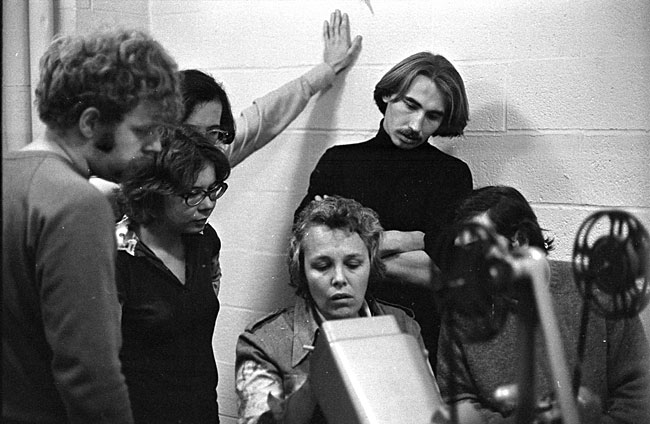
AG42.5 Barbara Kaster Photo

Student films were screened in the spring during the Annual Student Film Awards Night. The BFS co-sponsored the event and awarded an Oscar-replica statue to the Best Film. The event was by no means small. Some students dressed to the nines, some even renting a limo for the event.  In a phone interview, Kaster recalls that tickets would be made available at a given hour and would sell out within fifteen minutes. The campus support for student filmmakers was substantial.

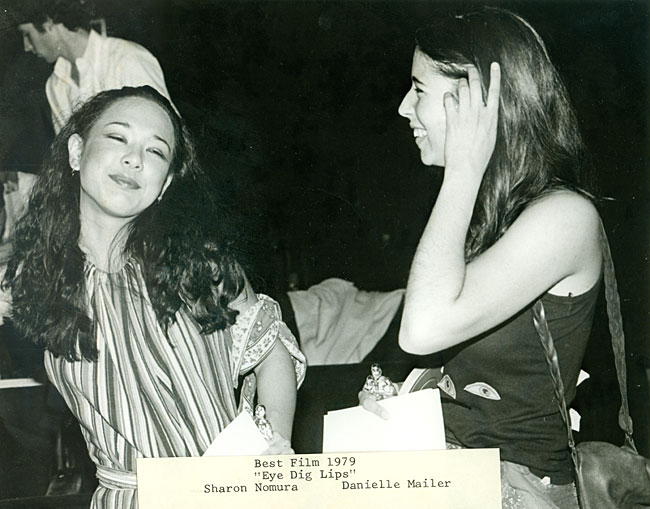
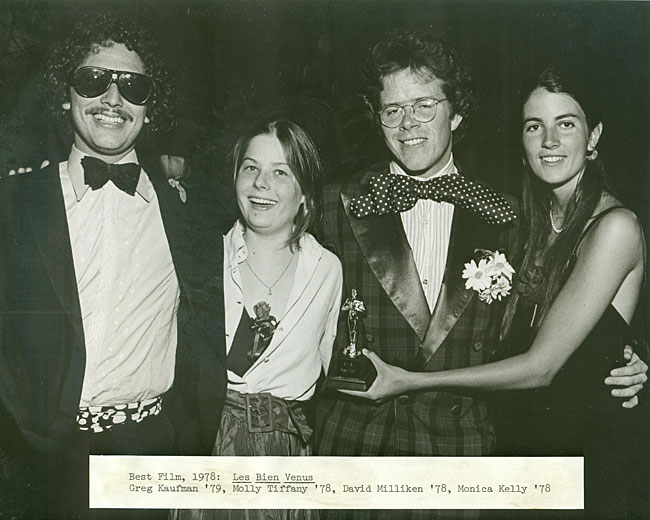
The flyer [DocumentAG, 42.1] announces the Fourth Annual Student Film Awards Night held in 1977. Current filmmaker, Liza McElaney ’77, made her first film, Pattern Grace, in Kaster’s Film History course and won Best Film at the student film festival her senior year [DocumentAG, 42.2]. In 1978 and 1979 the Best Film award again went to groups with women on them [DocumentAG, 42.3 and DocumentAG, 42.4]
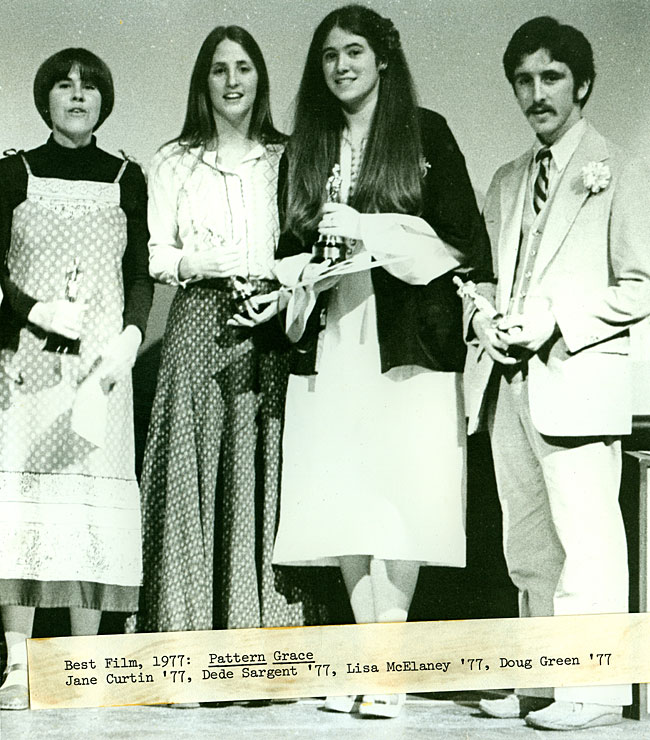
AG42.2 -  Bowdoin Film Society Awards 1977
AG42.2 - Bowdoin Film Society Awards 1977
AG42.3 -  Bowdoin Film Society Awards 1978
AG42.3 - Bowdoin Film Society Awards 1978
AG42.4 -  Bowdoin Film Society Awards 1979
AG42.4 - Bowdoin Film Society Awards 1979

The BFS allowed women to claim a space on campus where male membership did not predate their own. Kaster encouraged students, male and female, to take what they learned in the classroom and engage with the material in an interactive manner. Also, as one of the few female faculty members at Bowdoin in the early 1970’s, Kaster served as a mentor and role model for female students.  She and the BFS celebrated student achievements in a positive way, encouraging some women to pursue film as a career.  [DocumentAG, 42.5]
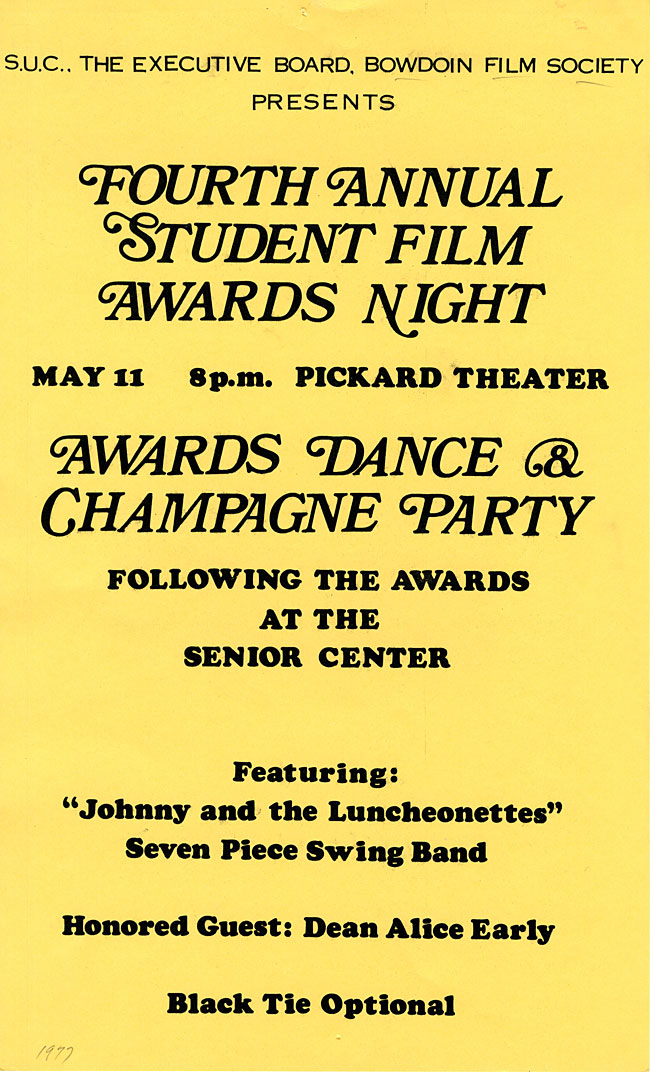
AG42.1 - Bowdoin Film Society Flyer

Filed Under: Documents, Extracurriculars Tagged With: 1977, 1978, 1979, AG42.1, AG42.2, AG42.3, Awards, Barbara Kaster, Bowdoin Film Society, Flyer, Liza McElaney

Joshua Chamberlain’s Inaugural Address

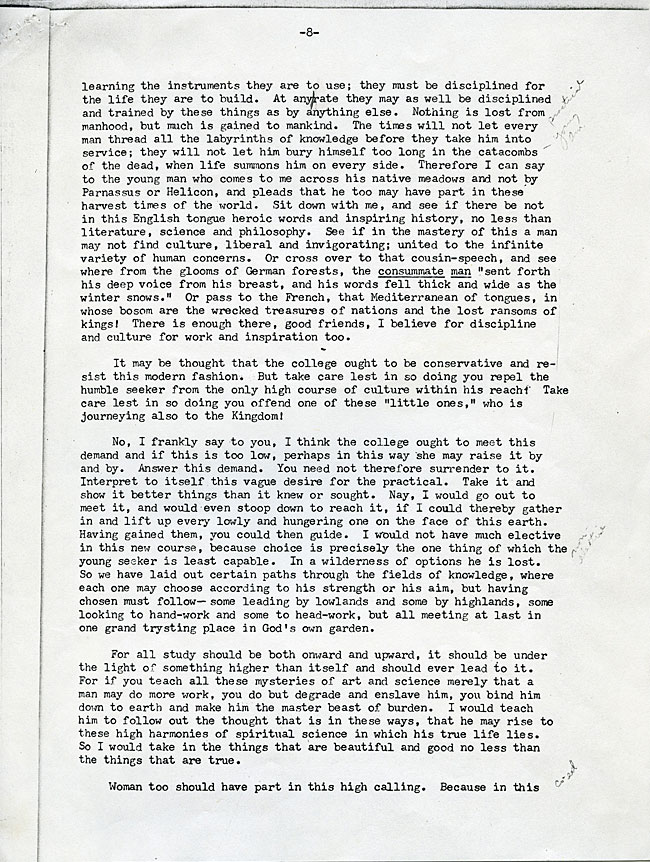
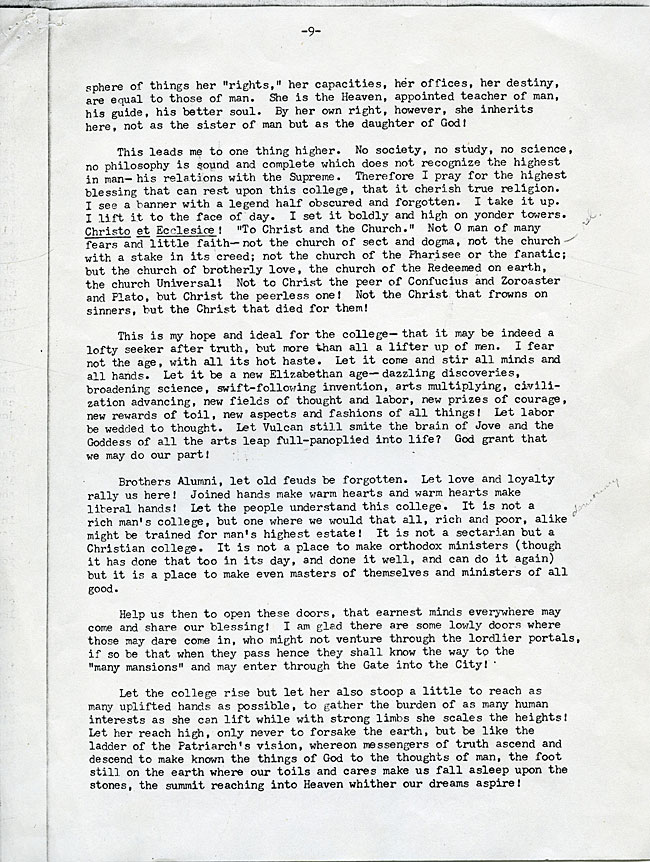
Opportunities for higher education for women were very rare in the early 1800s. Oberlin College opened its doors to women in 1833 and is recognized as the first college to become coeducational. The situation changed rapidly, though, in the late nineteenth and early twentieth centuries. Before 1870, only one in six women pursuing higher education did so at a coeducational college or university. Ten years later this changed to two in five women. Following the pattern, three in five women in higher education studied at coeducational institutions in 1880. Coeducation at this time, however, did not mean equal education. Women were admitted to increasing numbers of previously all-male colleges, but they were rarely welcomed to equal academic, social, and extracurricular experiences.

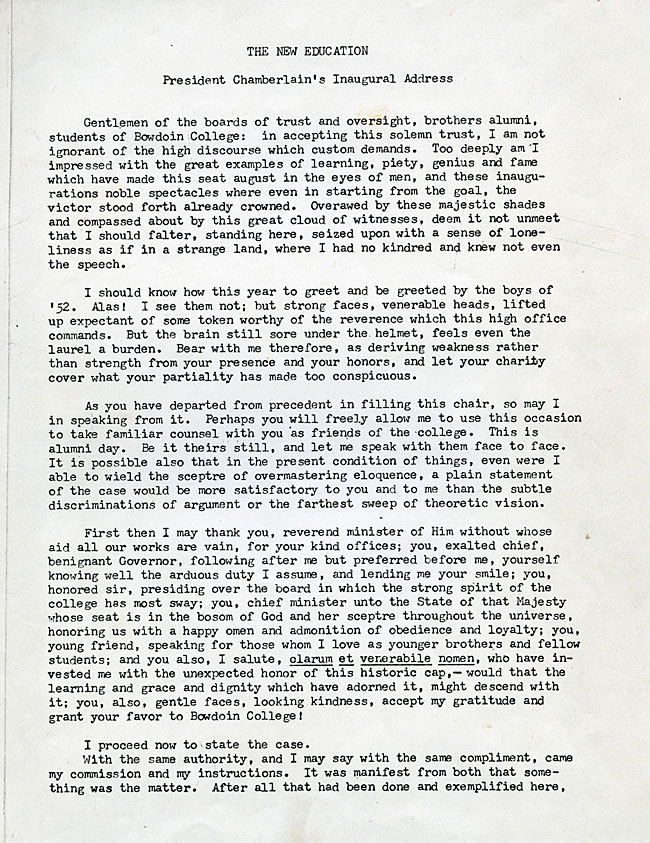
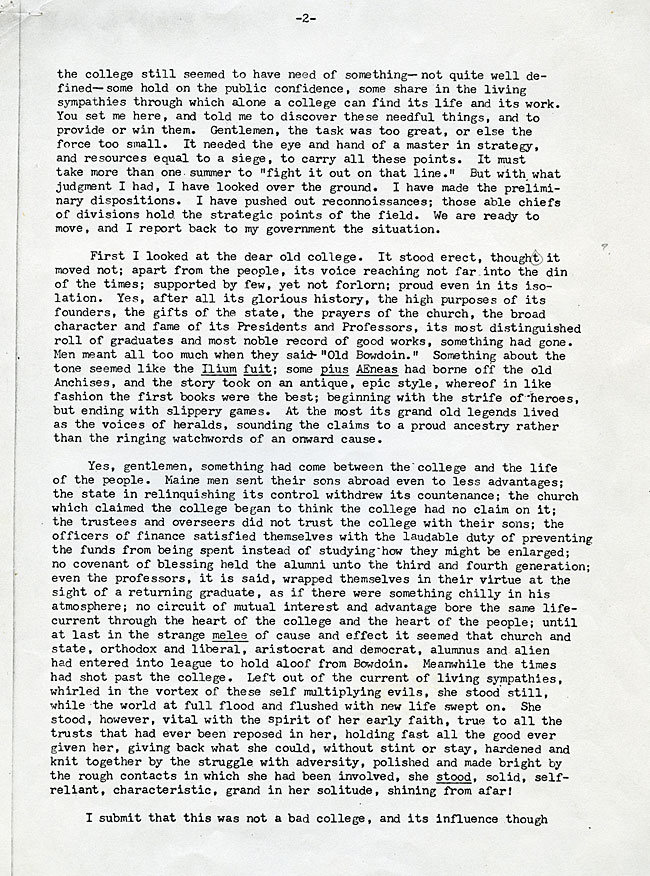
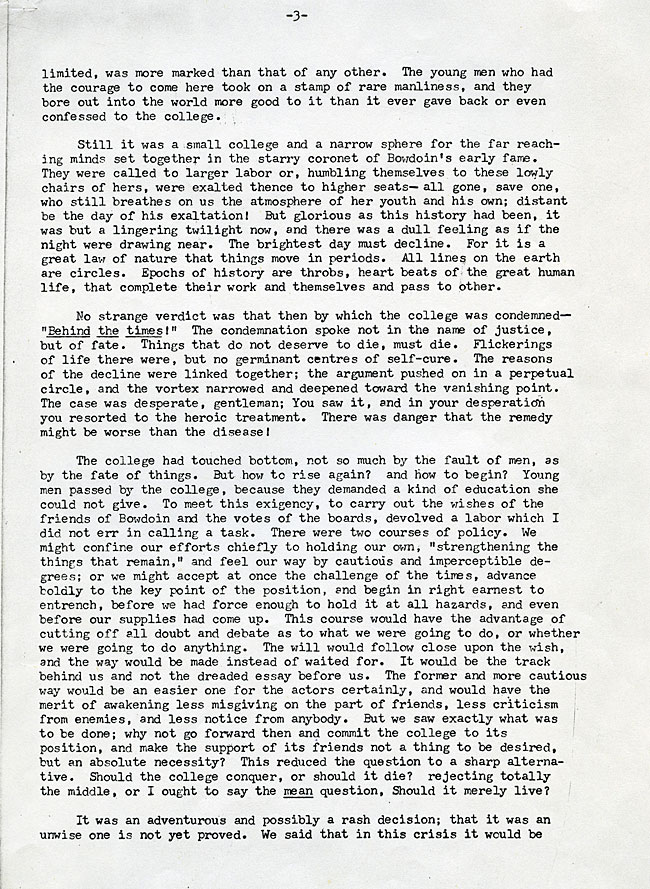
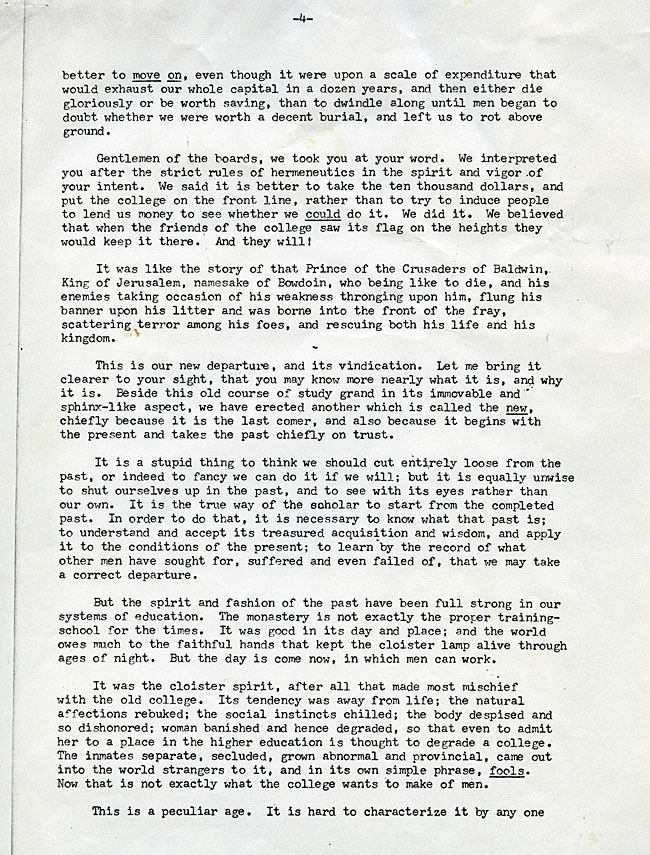
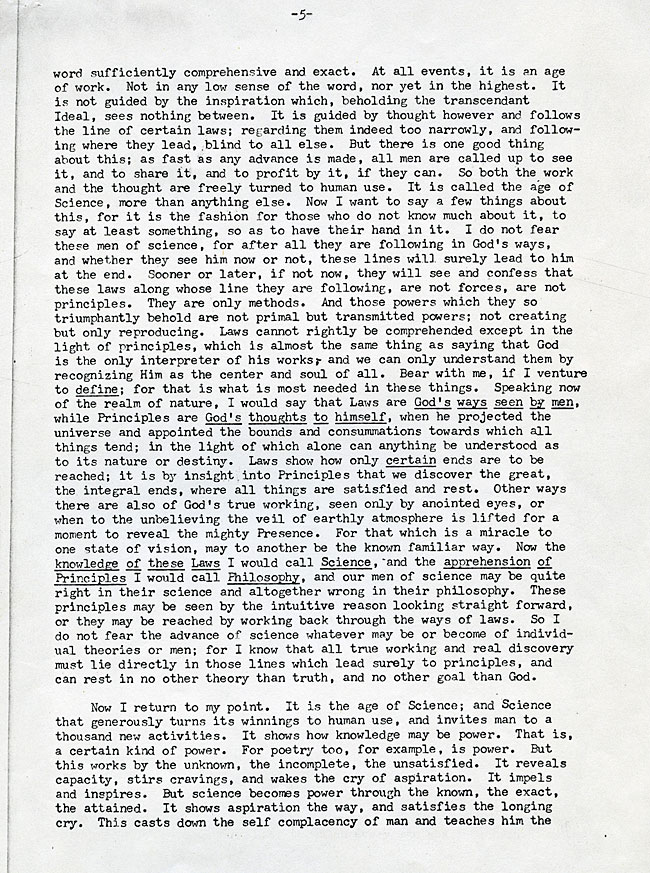
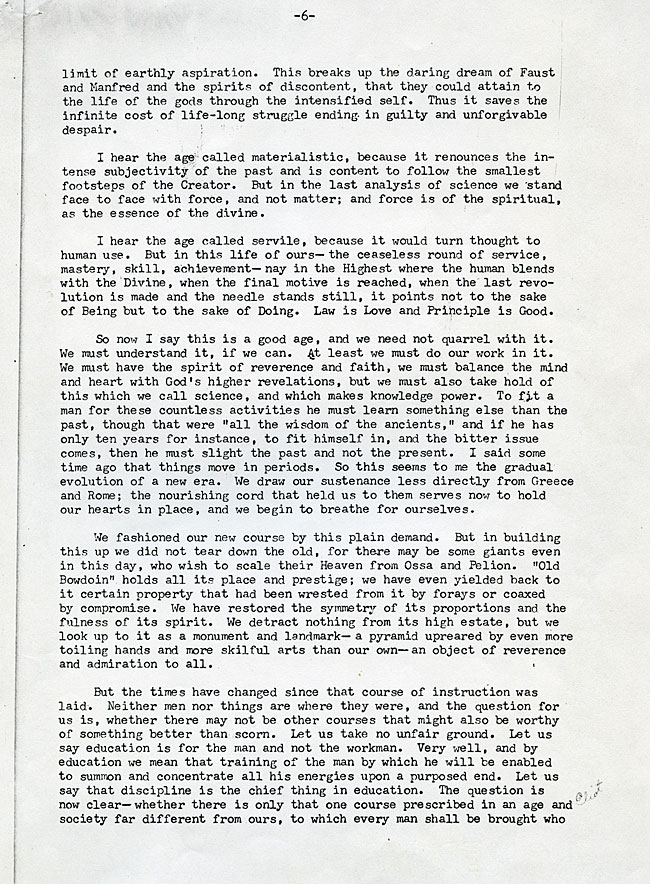
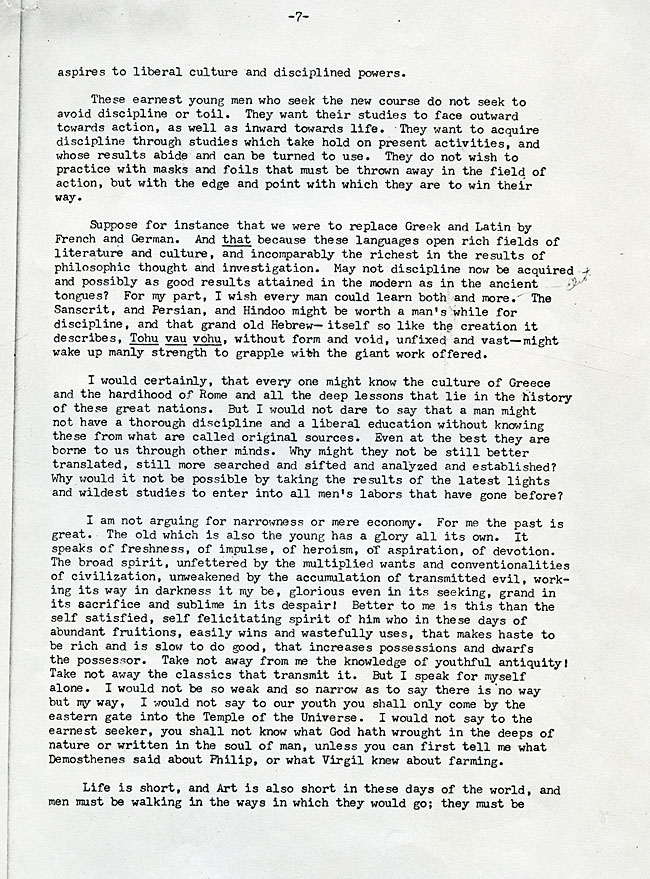
While many colleges became coeducational, single sex schools in the northeast resisted, primarily because with their better economic resources, they faced no financial burden by remaining single sex. By 1945, seventy percent of all institutions had become coeducational, and this number increased another five percent by 1955. But only in the late 1960s did Ivy-league colleges begin to make the transition, and once they did, many other schools, including Bowdoin, followed suit. The first mention of coeducation at Bowdoin was made many years earlier by Joshua Chamberlain, sixth president the College in his 1871 inaugural address (Document SC, 1). Interestingly, coeducation officially began at the college exactly one hundred years later in 1971.

Joshua Chamberlain's Inaugural Address - sc1-page-1
Joshua Chamberlain’s Inaugural Address – sc1-page-1
Joshua Chamberlain's Inaugural Address - sc1-page-2
Joshua Chamberlain’s Inaugural Address – sc1-page-2
Joshua Chamberlain's Inaugural Address - sc1-page-3
Joshua Chamberlain’s Inaugural Address – sc1-page-3
Joshua Chamberlain's Inaugural Address - sc1-page-4
Joshua Chamberlain’s Inaugural Address – sc1-page-4
Joshua Chamberlain's Inaugural Address - sc1-page-5
Joshua Chamberlain’s Inaugural Address – sc1-page-5
Joshua Chamberlain's Inaugural Address - sc1-page-6
Joshua Chamberlain’s Inaugural Address – sc1-page-6
Joshua Chamberlain's Inaugural Address - sc1-page-7
Joshua Chamberlain’s Inaugural Address – sc1-page-7
Joshua Chamberlain's Inaugural Address - sc1-page-8
Joshua Chamberlain’s Inaugural Address – sc1-page-8
Joshua Chamberlain's Inaugural Address - sc1-page-9
Joshua Chamberlain’s Inaugural Address – sc1-page-9

SC 1


Filed Under: Documents, Prehistory Tagged With: 1871, Inaugural Address, Joshua Chamberlain, Oberlin, SC1

The Summer School of Science

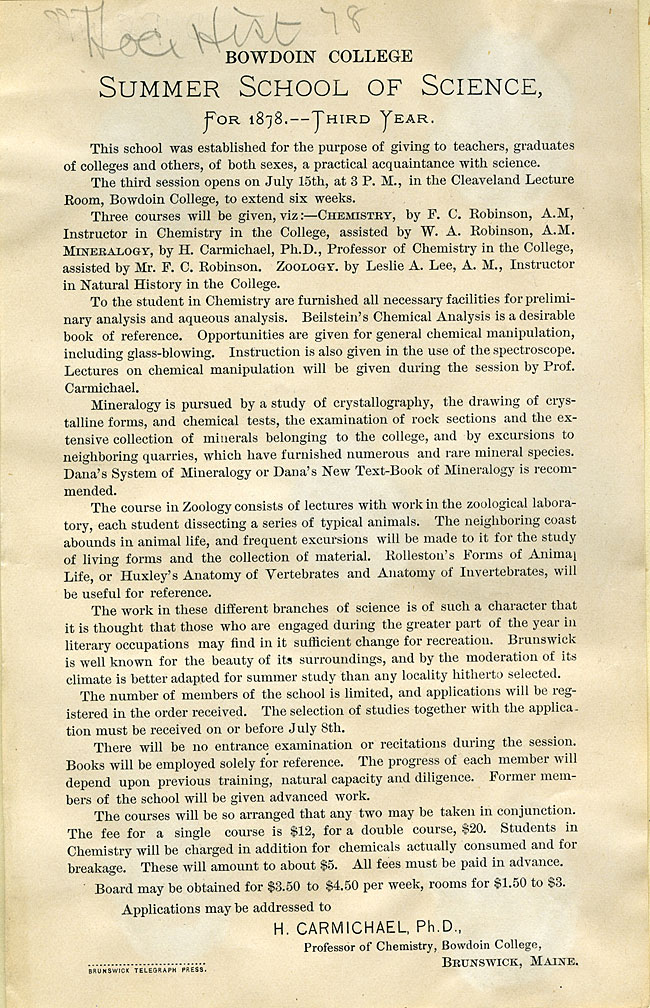
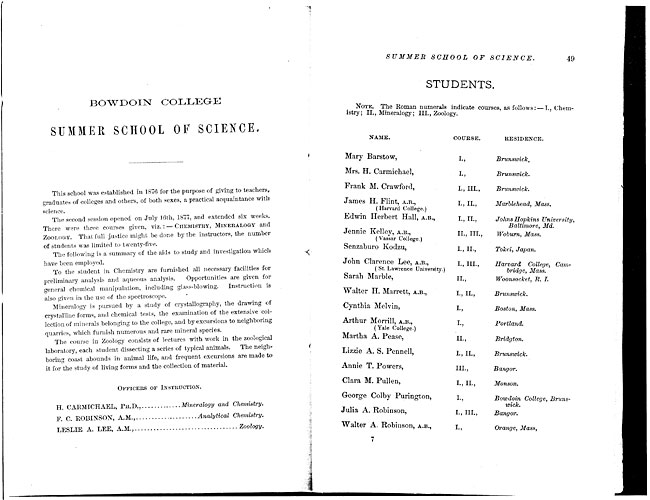
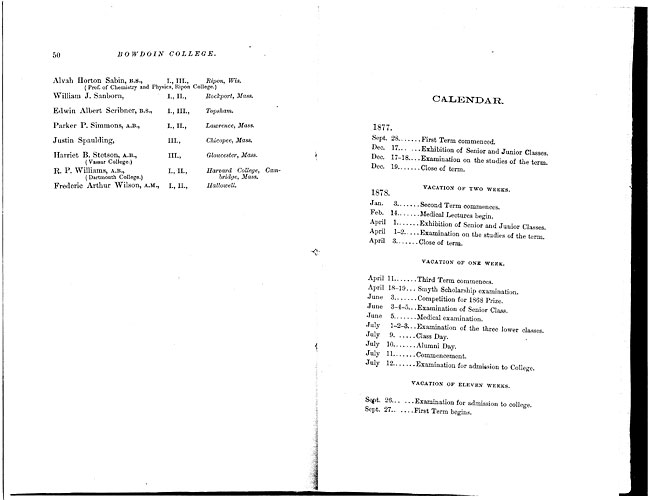
Contrary to what many people believe, women actually studied on campus at Bowdoin about one hundred years before coeducation was instituted. The Summer School of Science began at Bowdoin in 1876, and this institute included eleven women among twenty-seven students. The goal of the summer school program was to give students interested in the field an opportunity to practice. This program focused on chemistry, mineralogy and zoology, and students could take two concurrent classes.  Students were given the opportunity to dissect animals, handle chemicals, and go on trips to quarries to gain hands-on experience.  The only requirement was that students fill out an application, but space was limited. This document (Document SC, 2) provides a description of the Summer School of Science in its third year, 1878, and lists the names of the men and women enrolled.

Summer School of Science - sc-2
SC2 - The Summer School of Science

Filed Under: Documents, Prehistory Tagged With: 1876, 1878, SC2, Summer School of Science

Poem in the Bugle, “Bowdoin Coeds”

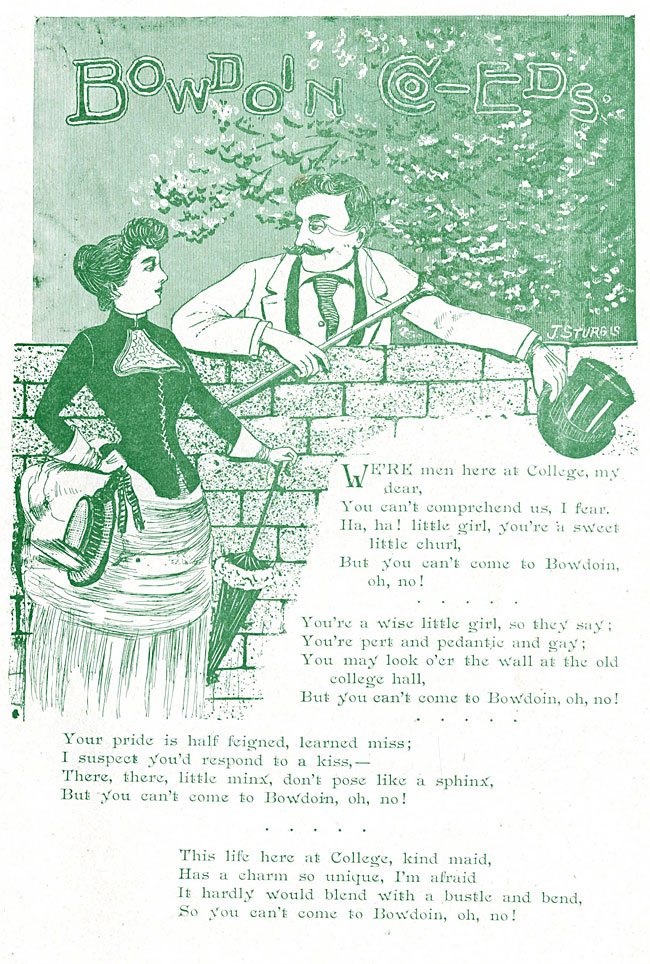
This poem (Document 3, GB) was published in 1890, in the Bowdoin College yearbook, which has been in continuous publication since 1847.  The mission of the yearbook states that it is “to document people, campus events, student organizations and athletics from a student’s perspective in a comprehensive volume to be published each academic year.”  By publishing this poem in the college yearbook, the editors make a statement that coeducation was not compatible with the values of the college.  In 1890, popular attitude still believed that women had no place in an institution like Bowdoin.

In 1890, men still felt superior to women and assumed that college, at least their college, was no place for women.  The picture that accompanies the poem depicts a wall separating the man from the woman symbolizes this definite separatism.  A century later, in 1971, Bowdoin finally became coeducational.  And today, in 2011, more women than men attend Bowdoin.


GB3 - Poem in the 1890 Bugle, "Bowdoin Coeds"

Filed Under: Documents, Prehistory Tagged With: 1890, Bowdoin Coeds, Bugle, GB3, Poem, Yearbook

Society of Bowdoin Women Constitution

The Society of Bowdoin Women was established in 1922 for two main purposes; first, to help with the endowment, and second, to offer a hospitable place for women while they waited on the campus. The Society offered a gathering place for women to wait for “their” Bowdoin men and to meet other women. Members had to pay annual dues. They also had to “love” a Bowdoin man, whether he be a grandson, son, brother, husband, or friend.

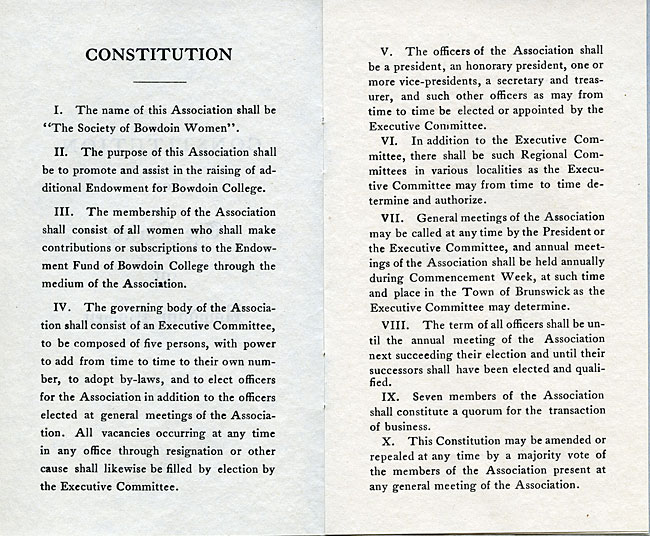
The Society was composed of a governing board of five people including president, honorary president, vice-president, secretary and treasurer. The honorary president was the role reserved for the College president’s wife. The remaining members of the Executive Board held their positions for two years and took turns doing so.

The Society had a positive impact on the College. The Constitution states that the intention of the society was to assist in the College’s endowment (Document SC, 4). In addition to this, with their annual dues the group was able to make small donations to the College, including china for the Dean’s house and a television for the Infirmary. The members also sponsored lectures by exceptional women. They established the Edith Lansing Sills Lecture Fund in honor of Mrs. Sills, wife of a former Bowdoin president. This became a biannual lecture on campus. The most recent Edith Lansing Sills Lecturers at Bowdoin were Anita Hill in 2008 and Bettye Collier-Thomas in 2011.

Society of Bowdoin Women Constitution - sc4-1
Society of Bowdoin Women Constitution - sc4-1.1

SC 4

Filed Under: Documents, Prehistory Tagged With: Constitution, Edith Lansing Sills Lecture, SC4, Society of Bowdoin Women

  • « Previous Page
  • 1
  • …
  • 6
  • 7
  • 8
  • 9
  • 10
  • …
  • 17
  • Next Page »

Categories

  • Athletics (9)
    • Documents (6)
    • Focus Group (1)
    • Oral History Interview (2)
  • Curriculum (8)
    • Documents (6)
    • Focus Group (1)
    • Oral History Interview (1)
  • Extracurriculars (10)
    • Documents (6)
    • Oral History Interview (3)
  • Prehistory (20)
    • Documents (18)
    • Oral History Interview (2)
  • Process (22)
    • Documents (12)
    • Focus Group (3)
    • Oral History Interview (7)
  • Social Life & Fraternities (20)
    • Documents (12)
    • Focus Group (3)
    • Oral History Interview (5)
  • Women’s Resource Center (8)
    • Documents (6)
    • Focus Group (1)
    • Oral History Interview (1)
  • Sources
  • Acknowledgments

Copyright © 2026 · research.bowdoin.edu · Powered by WordPress