Studies in human–machine co-creative collaborations
HUMAN–MACHINE
CO-CREATION
Project description
When two musicians improvise together, each listens and responds while forming expectations about how the other’s timing, phrasing, and expressive gestures will unfold. Most of these expectations come from the sound itself and from knowing a partner’s playing; body movement adds cues, especially when timing is uncertain. Two research areas have explored this largely separately. At IRCAM (the Institute for Research and Coordination in Acoustics/Music, a Paris-based center for music research and creation), co-improvisation systems such as Somax2 and Dicy2 respond to musicians mainly by listening to their audio or MIDI. Research on multimodal performance shows that musicians’ movements carry information about timing and interaction. This project brings the two together, asking whether performer-specific models of physiological and movement data improve a computational partner’s anticipation beyond audio and MIDI alone.
We synchronize audio, MIDI, MIDI Polyphonic Expression when available, gesture and motion capture, facial measurements, EEG (brain activity), and EMG (muscle activity). Models trained on each performer’s recordings predict pauses, phrase changes, and shifts in intensity using only data recorded before each event, so they can run live. The system responds over MIDI, including through a Steinway Spirio self-playing piano, and records the performer’s reaction, closing a feedback loop.
and bodily signalsExtract features and apply
a personalized modelGenerate a musical responseThe performer hears
and responds
The performer improvises using a MIDI-capable instrument. Audio and selected bodily signals provide complementary observations.
Musical and physiological measurements are timestamped, checked for quality, and aligned for a personal research dataset.
Extracted features support a personalized model of defined musical events. The model estimates possible developments in the performance.
Predictions inform generative musical choices. MIDI output can drive a compatible instrument, including a connected Steinway Spirio.
The performer hears the system’s contribution and makes the next musical decision. Subsequent measurements begin another cycle.
Research team
CEMA · Bowdoin College

Principal investigator
Badie Khaleghian
Music · CEMA
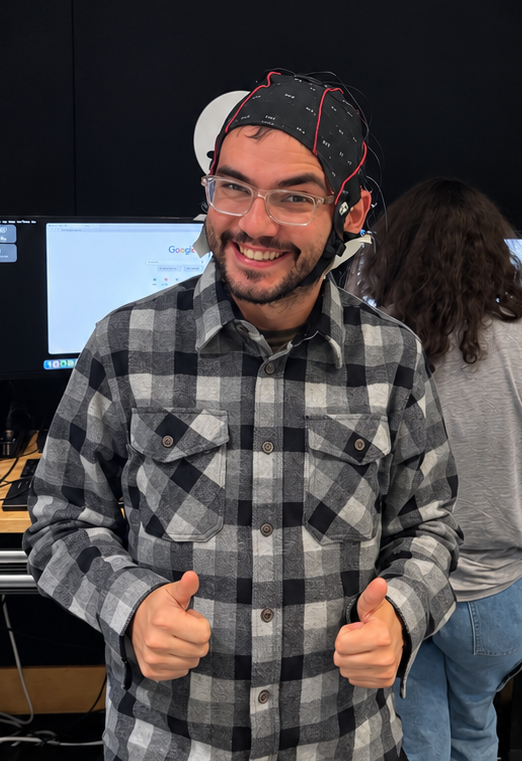
Co-principal investigator
Jeová Farias
Computer Science
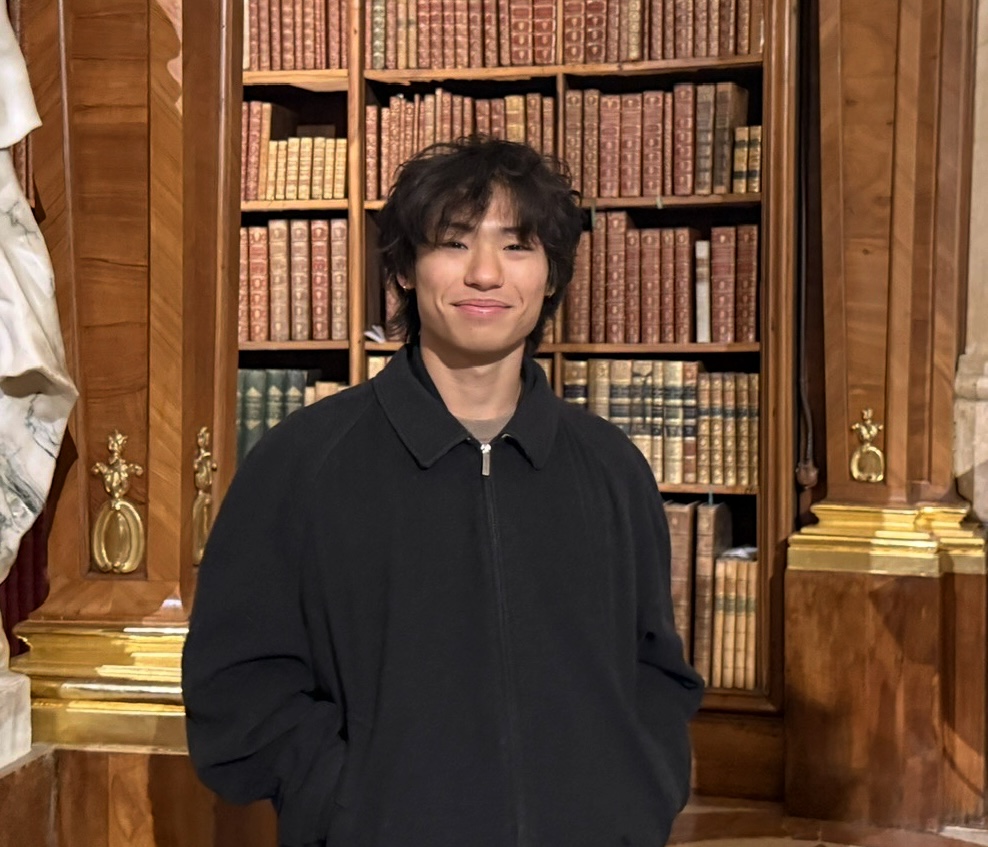
Student researcher
Jintae Park
Bowdoin College

Student researcher
Shahd Hekal
Bowdoin College

Student researcher
Johann Ocampo
Bowdoin College
Background
Improvisation involves
learning your partner.
Musicians develop expectations through shared experience. They anticipate timing, phrasing, and gesture—and revise those expectations as the music changes. We take this flexible anticipation as a design principle for a creative AI partner.
Learn a performer
Build from an individual’s own playing and embodied practice.
Anticipate possibilities
Form useful expectations while remaining open to surprise.
Create together
Support, complement, contrast, or leave space for the musician.
The artistic motivation
This research grows from Badie Khaleghian’s work across composition, improvisation, responsive media, and brain–computer interfaces. The aim is to design a partner whose musical behavior develops from a particular performer’s practice, with the performer shaping the data, the musical vocabulary, and the terms of the interaction.
Why this research belongs at CEMA
CEMA brings teaching, rehearsal, research, and performance into the same environment. Its spatial sound, immersive projection, instruments, and computing systems support repeated experiments in which sensing, analysis, and artistic response can be developed together.
The same setting lets students investigate the technical system and its musical consequences.
Research precedents
Dicy2 · IRCAM
Learning musical vocabulary and interaction through improvisation, with reactive and planned generation. Developed from the DYCI2 research project.
Somax2 · IRCAM
Live co-improvisation shaped by machine listening and a musical corpus chosen by the user.
jam_bot · MIT Media Lab
A real-time improvisation system developed with Jordan Rudess and fine-tuned on his performances.
CEMA’s question: what can synchronized musical, bodily, and physiological signals add to a personalized creative partnership? These projects provide context; they are not CEMA collaborators.
Goals
From personal data
to a creative partner.
Our central question is whether additional performance signals improve anticipation and musical interaction beyond an audio-and-MIDI baseline.
Explore the proposed inputs
Select a signal to see what it records and what we need to test.
Audio
- What it records
- The sounding performance: timing, dynamics, timbre, and musical texture.
- Research question
- Which audible changes help anticipate the next musical event?
- What we need to test
- Verify recording and replay, and measure alignment with instrument events.
MIDI / MPE
- What it records
- Notes, timing, velocity, and control messages from any MIDI-transmitting instrument; additional MPE data where available.
- Research question
- How do a performer’s touch and phrasing relate to what happens next?
- What we need to test
- Validate message support and timing for each configuration. Generated MIDI can drive receiving instruments, including a connected Steinway Spirio; MPE is optional.
Gesture
- What it records
- Gesture-derived controls from ROLI Airwave.
- Research question
- Do gestures provide useful cues before or alongside a musical change?
- What we need to test
- Document control ranges, timestamps, and correspondence with the performance.
Movement
- What it records
- Available motion channels, with acceleration and rotation identified separately.
- Research question
- Does movement add predictive information beyond sound and instrument data?
- What we need to test
- Establish what each channel measures and distinguish movement from sensor artifacts.
Face
- What it records
- Selected numerical facial measurements derived with MediaPipe.
- Research question
- Are repeatable facial movements associated with musically meaningful events?
- What we need to test
- Define a small feature set and test recording alongside other streams. Measurements are not emotion labels.
EEG
- What it records
- Electrical activity measured at the scalp, with processing documented.
- Research question
- Do reliable EEG features add useful information for a defined musical prediction task?
- What we need to test
- Check electrode contact, movement artifacts, transmission, and the calculation of band power.
EMG
- What it records
- Surface electrical activity associated with muscle activation.
- Research question
- Can muscular activity help characterize the preparation or execution of musical gestures?
- What we need to test
- Distinguish meaningful muscle activity from artifacts and evaluate its contribution to musical prediction.
Personal dataset
Record & align
Capture repeatable sessions. Preserve timestamps, assess signal quality, and annotate musical events.
Personalized AI
Model & evaluate
Define prediction tasks, learn performer-specific relationships, and test on held-out sessions.
Musical interaction
Generate & listen
Use predictions to inform a partner’s musical choices. Evaluate the experience with performers.
Instrument compatibility: MIDI, MPE, and Steinway Spirio
The architecture is designed around MIDI rather than a specific keyboard. An instrument or controller that transmits MIDI can supply note and control data. An instrument that receives MIDI can perform generated output; this includes synthesizers, software instruments, and a suitably connected Steinway Spirio player piano.
MPE is an optional source of additional expression data. Standard MIDI instruments can participate without it. Each configuration requires verification of its supported messages, routing, and latency; this is an intended general interface, not a claim that every instrument has already been tested.
What “personal” means here
A personal research dataset contains synchronized recordings of a performer’s musical and bodily activity. A personal musical corpus contains selected audio or MIDI material that can supply a generative system’s vocabulary. They serve different purposes and may be connected in the eventual system.
The proposed design gives the performer a role in choosing the material, defining useful musical behavior, and evaluating how the partner responds.
Aimed outcomes
Artistic and scientific
outcomes.
The intended outcomes combine artistic performance, a working research system, and documented methods that others can examine and build on.
Featured artistic outcome · in development
NEURAL
DUET
Badie Khaleghian and a computational musical partner performing through a Steinway Spirio player piano.
22 MAY 2027 · 7:30 P.M.
Third Angle New Music
The Vault Theater · Hillsboro, Oregon
Presented by Third Angle New Music in the Portland metropolitan area.
The performance aims to connect a personal dataset of improvisation and EEG with an AI model whose musical responses are realized through the Spirio’s MIDI connection.
Artistic
An improvising co-creator
A partner that can contribute musically while leaving meaningful choices with the performer.
Technical
A reusable research system
A synchronized recorder, personal pilot datasets, predictive models, and a real-time interaction prototype.
Research
Evidence & documentation
Comparisons, performance studies, papers, and methods or code suitable for sharing, with appropriate permissions.
These are intended outcomes. The current project has not yet established that additional modalities improve prediction or artistic interaction.
Application
Closing the biofeedback loop.
Physiological measurements inform a musical response. The performer hears it, responds, and is measured again. This creates a way to study how sound, bodily activity, and creative decisions influence one another over time.
Explore the proposed study
Conceptual walkthrough. No live sensor data or trained AI model is running on this page.
Step 1 of 4 · Adaptive condition
Measure
Record the performer’s musical activity and selected physiological signals. Check their quality and temporal alignment.
Explore the proposed study
Conceptual walkthrough. No live sensor data or trained AI model is running on this page.
Step 2 of 4 · Adaptive condition
Interpret
Calculate selected features and apply a personalized model to a clearly defined task, such as anticipating a change in musical activity.
Explore the proposed study
Conceptual walkthrough. No live sensor data or trained AI model is running on this page.
Step 3 of 4 · Adaptive condition
Respond
Use the model’s output to inform the musical partner’s timing or material. A MIDI-receiving instrument, including a connected Steinway Spirio, can realize the response.
Explore the proposed study
Conceptual walkthrough. No live sensor data or trained AI model is running on this page.
Step 4 of 4 · Adaptive condition
Measure again
Record what happens after the response. The performer may change their playing, movement, or physiological activity, creating the next input.
Explore the proposed study
Conceptual walkthrough. No live sensor data or trained AI model is running on this page.
Step 1 of 4 · Comparison condition
Measure
Continue recording the performer while the same fixed musical stimulus is played. This makes the conditions comparable.
Explore the proposed study
Conceptual walkthrough. No live sensor data or trained AI model is running on this page.
Step 2 of 4 · Comparison condition
Interpret
Analyze the measurements for comparison, but do not use them to change the playback.
Explore the proposed study
Conceptual walkthrough. No live sensor data or trained AI model is running on this page.
Step 3 of 4 · Comparison condition
Respond
Play a predetermined recording. It does not adapt to the performer’s current measurements.
Explore the proposed study
Conceptual walkthrough. No live sensor data or trained AI model is running on this page.
Step 4 of 4 · Comparison condition
Measure again
Record the performer’s response to the fixed stimulus. Compare the resulting interactions with the adaptive condition.
What would we test?
Timing
Are the measurements and responses aligned with the performance?
Contribution
Does adding a signal improve prediction over the musical baseline?
Experience
Does the performer find the response useful, coherent, and open to influence?
Biofeedback, adaptation, and research limits
In the adaptive condition, measured activity changes the system’s response. A fixed-playback comparison removes that dependency while preserving an audible stimulus. Recording both sides helps examine feedback effects; observed relationships alone do not establish causation.
Updating predictions during a performance is distinct from retraining model weights online. EEG and EMG are measurements requiring interpretation and quality checks, not direct readings of intention or emotion. Clinical applications would require separate studies; this project currently concerns artistic interaction and research methods.