
For Bowdoin students
Classes &
student research
Study with Badie Khaleghian through courses, the Bowdoin Electro-Acoustic Ensemble, and research at CEMA. Find a starting point based on what you want to make or investigate.
Courses & ensemble
Take a class with Badie Khaleghian
Upcoming courses · Spring 2027
MUS 1551 · Spring 2027
Video Game Music and Sound Design
Create audio for games through composing, recording, synthesis, and editing.
Experience: Beginners welcome; no previous experience required.
Meets: Tue / Thu, 10:05–11:30 a.m.
MUS 2562 / DCS 2662 / DANC 2310 · Spring 2027
Digital Realities
Introducing Immersive Technologies for Storytelling
Build interactive environments at CEMA using spatial audio, projection, sensors, and creative coding. Develop three short projects and a final work.
Preparation: Ask about the course’s fit with your background.
Meets: Tue / Thu, 1:15–2:40 p.m.
MUS 2761 / MUS 2762 · Spring 2027
Electro-Acoustic Ensemble
Develop original group performances through improvisation, live electronics, and multimedia practice.
Experience: Musical training and music-reading skills are not required.
Meets: Mon, 6:30–9:30 p.m.
Course times follow Bowdoin’s Spring 2027 schedule, dated October 21, 2026. Check the official listing for current enrollment and registration details.
Current course schedules Music catalogue and prerequisites
Interested in electronic music or composition? Ask about future offerings of Introduction to Electronic Music (MUS 2551), composition, or which course matches your interests.
Research & independent study inquiries
Explore student research
Students with interests across the arts and sciences can contact CEMA about research. Start with an area that interests you and the skills you want to develop. Different projects require different preparation.
Direction to discuss
Music & computing
Question: How can a computational system respond to a performer’s sound, movement, and musical decisions?
Possible contributions: Recording tools, time alignment, signal analysis, and testing responsive musical systems.
Relevant interests: Programming, music, mathematics, or data analysis.
Direction to discuss
Body signals & musical interaction
Question: How can movement or physiological measurements be mapped to musical material?
Possible contributions: Working with sensors, inspecting recordings, developing mappings, and documenting tests.
Relevant interests: Neuroscience, physics, computing, or sound.
Direction to discuss
Interactive sound & visual media
Question: How do sound, projection, and movement work together in an interactive installation or performance?
Possible contributions: Prototyping an interface, designing audiovisual material, and testing interactions in the room.
Relevant interests: Visual art, performance, composition, design, or creative coding.
Discuss a research opportunity
Send a short introduction with your class year and area of study, the topic that interests you, relevant experience, and your availability. You can also describe skills you would like to learn.
Current project availability, preparation, weekly time commitment, and any credit or funding arrangements are discussed with Badie Khaleghian before work begins.
Student work
What students make and investigate
Immersive multimedia
Digital Realities
Immersive multimedia work by Aden Ho, Erik Infante, Elina Kapur, Matt Orlando, and Luke Vazdauskas. Explore how students combine sound, image, and space in a public presentation.
Performance
Custom digital instruments
Students developed original solo, duo, and quartet works using motion and biodata. The program shows how interface design and performance can develop together.
Research
Music & brain–computer interfaces
Jintae Park’s exploratory research connects EEG data and a player piano. The work involves data acquisition, computational mapping, and musical motifs.
Ensemble participation
Bowdoin Electro-Acoustic Ensemble
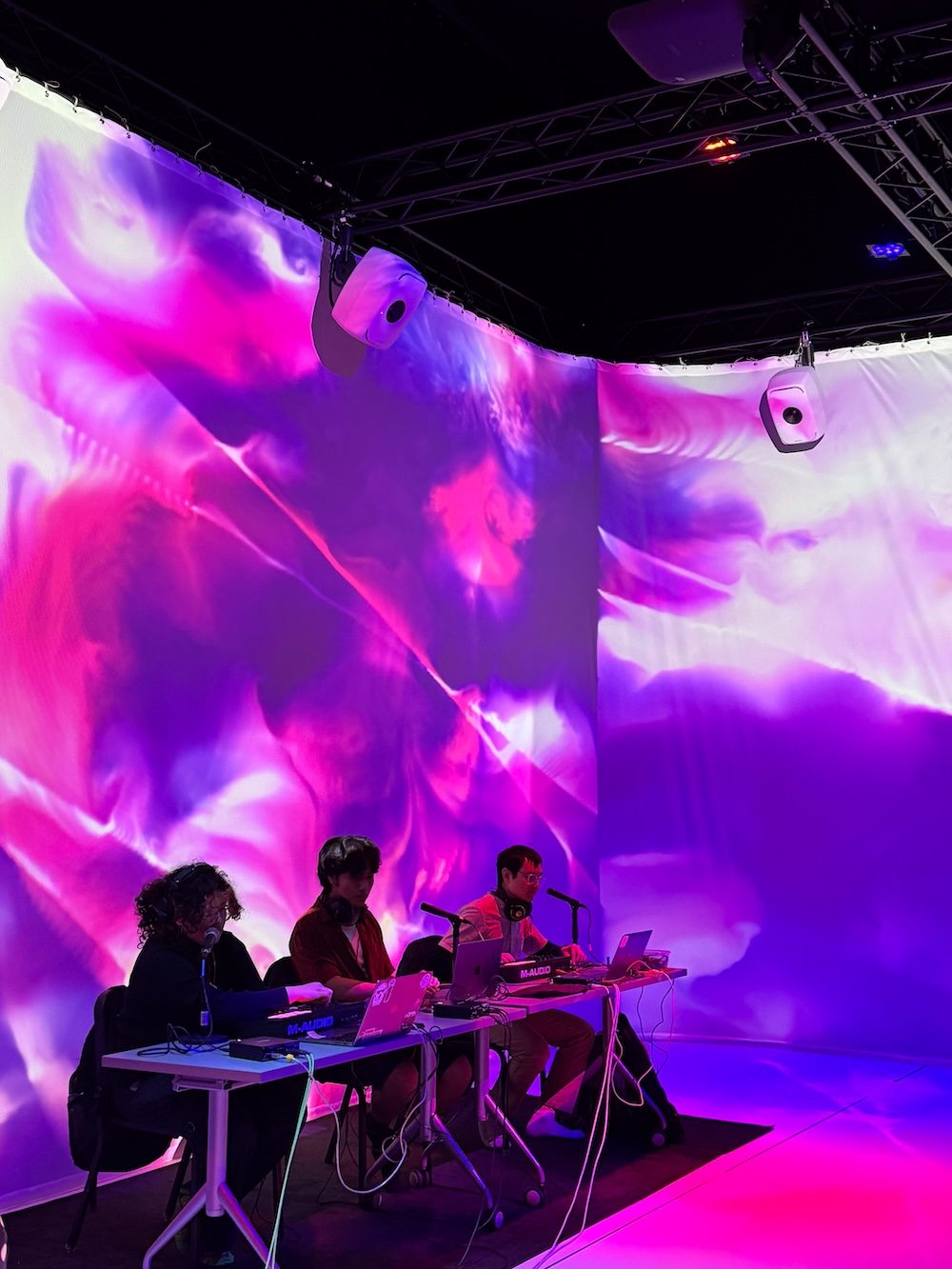
No prior musical experience or ability to read music is required to join the ensemble.
The ensemble rehearses at CEMA and develops original work through improvisation, sound design, live electronics, and multimedia installation.
Students experiment with custom digital instruments and collaborative performance. Contact Badie Khaleghian to discuss joining and preparing for your first rehearsal.
Student performances
See the ensemble in action
Recordings from the Bowdoin Electro-Acoustic Ensemble, shared on CEMA’s YouTube channel.
BEE · SP 26 Q
An ensemble recording from the channel’s Spring 2026 collection.
BEE · Alberto & Jack
A duo performance by Alberto and Jack.
Your first session
Plan your first studio session.
Tell us your idea
Share what you want to make, the class or project it connects to, and any experience you already have. We can help identify a practical starting point.
Plan access & setup
Coordinate an introduction to the room, the equipment you need, and any training or support before your first session.
Reserve time & experiment
Use the booking page to find a session. Confirm access and technical needs with CEMA, and bring your project files and a backup.
Before your session, gather your media files, project dependencies, and a local backup.