
On Campus Event: Sketching Science: Scientific Communication through Social Media, Thurs. April 5 @ 7:30 PM, Beam
Sketching Science: Scientific Communication Through Social Media with Ernesto Llamas
Thursday, April 5, 2018 | 7:30 PM – 8:30 PM
Beam Classroom, Visual Arts Center
Dr. Ernesto Llamas created the Journal of Sketching Science, which aims to increase the visibility and impact of scientific research through accurate and attractive illustrations. Using social media, Sketching Science has reached nearly 400,000 followers and publishes almost every week. This talk will feature how illustrations helped explain his Ph.D. research, what it means to make science viral in social networks, and his recent collaboration with international scientists and artists.
Website: https://journal.sketchingscience.org
Free of charge and open to the public. Sponsored by Bowdoin Student Scientists and the Departments of Biology, Biochemistry, and Chemistry
Before the lecture, there will be a dinner with Dr. Llamas from 5-6PM in Thorne Mitchell South.

On Campus Event: “The Smoke of London: Energy and Environment in the Early Modern City” Friday, April 6 10-11:30 AM
“The Smoke of London: Energy and Environment in the Early Modern City” with William Cavert
Friday, April 6 from 10-11:30 AM
Nixon Lounge, Hawthorne Longfellow Library (3rd Floor)
A behind the scenes look at Bowdoin’s special collections with William Cavert, assistant professor of history, University of St. Thomas.
By 1600, London was a fossil-fueled city, its high-sulfur coal a basic necessity for the poor and a source of cheap energy for its growing manufacturing sector. In this lecture, drawn from his prize-winning book, historian William Cavert uncovers the origins of urban air pollution, two centuries before the industrial revolution.
Sponsored by the Department of History and Environmental Studies Program

Off Campus Event: “Years of Living Dangerously: Safe Passage”, presented by the Citizen’s Climate Lobby, Monday April 2 @ 6:30 PM

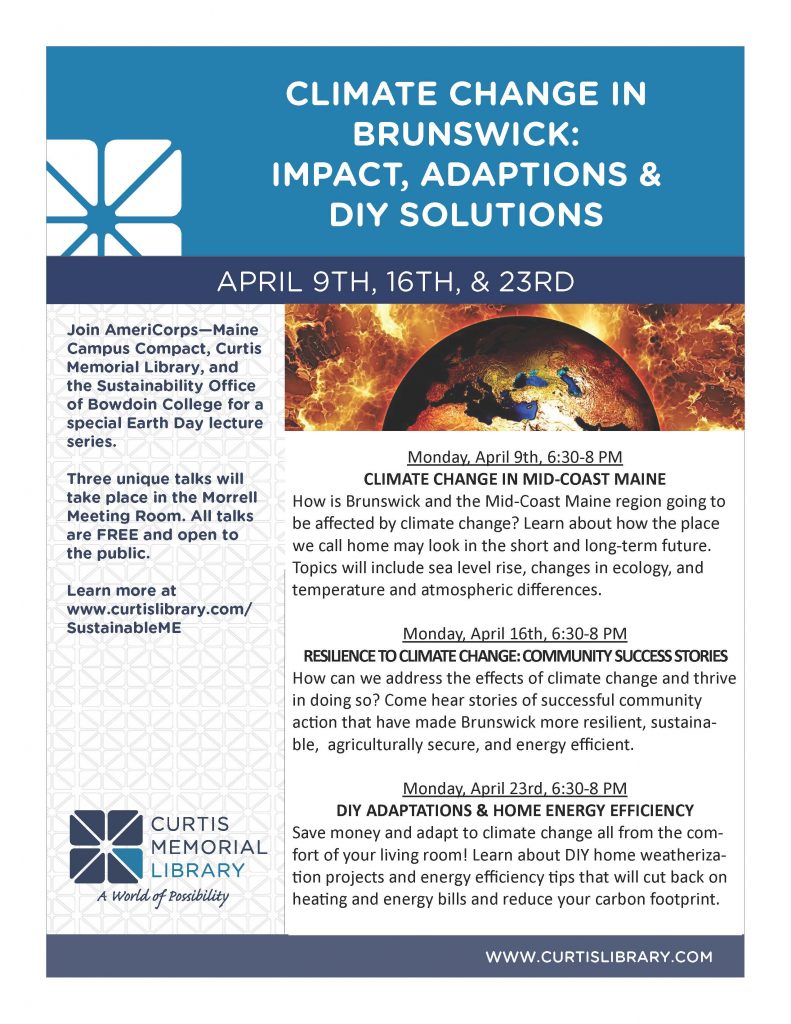
Off Campus Events: Climate change in Brunswick: Impact, Action and Adaptations, April 9, 16 & 23rd 6:30 PM, Curtis Memorial Library
Climate Change in Brunswick: Impact, Action, and Adaptations
A community lecture series in celebration of Earth Day
Brunswick’s Curtis Memorial Library’s Morrell Meeting Room: April 9, 16, 23rd: 6:30-8pm
Monday, April 9th, 6:30-8 PM
Climate Change’s Effects in Brunswick
How is Brunswick and the Mid-Coast Maine region going to be affected by climate change? Learn about how the place we call home may look in the short and long-term future. Topics will include ecological, economical, oceanic, and atmospheric changes and challenges.
Presenters Include:
- Sophie Janeway, Natural Resources Council of Maine: “An Overview of Climate Change in Mid-Coast Maine”
- Beth Bisson, Maine Sea Grant: “ Ecological Shifts and Challenges”
- David Carlon, Bowdoin Professor/Director of the Bowdoin Schiller Coastal Studies Center: “Climate Change in the Gulf of Maine: Changes in Fisheries, Marine Biology, and Coasts”
Monday, April 16th, 6:30-8 PM
Resilient Brunswick: Community Environmental Action
How can we address the effects of climate change and thrive in doing so? Hear how local community members successful actions to make Brunswick and Maine more resilient, sustainable, and energy efficient.
Presenters include:
- Mark Berry, The Nature Conservancy: Forest Program Director: “The Role of Forests in Tackling Climate Change”
- Marcia Harrington, Brunswick Plastic Bag Ban, “Organizing Community Environmental Action”
- Eileen Johnson, Bowdoin College:“Resilience Building in Brunswick”
Monday, April 23rd, 6:30-8 PM
DIY Adaptations: Home Energy Efficiency
Save money and adapt to climate change from the comfort of your living room! Learn about DIY home weatherization projects and energy efficiency tips that will cut back on heating and energy bills while reducing your carbon footprint.
Presenters include:
- Steve Ward, Maine Climate Table: “Maine’s Energy Efficiency Legislative History and Future”
- Nat Blackford, Efficiency Maine: “Energy Efficiency Programs and Incentives”
- Jen Hatch, Revision Energy: “Solar Energy and Installation”

Off Campus: “Cultivating a Culture of Science”, April 28
“Cultivating a Culture of Science”, 2018 MEEA Conference
April 28 at Colby College
You can learn more about it on our website:MEEA Website We have a great track on Green Leadership that might be really interesting for Bowdoin students and many youth presenters… if you have any students interested in networking and growing their connections in environmental and conservation education and outreach I have scholarships available…please urge them to contact me! Thank you so much!
Summer Fellowship: National Audubon- work on an island in Southern or Midcoast Maine
National Audubon Fellowship
Application Deadline: Monday April 1, 2018.
Click here to apply for a National Audubon Fellowship
Location: Southern and mid-coast Maine at an island field camp
Housing: Housing and meals are provided (see details below) and provides a biweekly stipend of $525
For more info: National Audubon Maine Coast seabird nesting sanctuaries
Position Description: Audubon’s Seabird Restoration Program operates seven island field stations along the Maine coast as critical seabird nesting sanctuaries. Research Interns will work under the direction of the Island Supervisor, participating in all aspects of seabird research, monitoring, and management that take place at the field station. The majority of research projects focus on studying the nesting success and foods fed to seabird (tern and alcid) chicks, with most work focusing on terns. Work includes, but is not limited to: conducting population censuses, monitoring productivity and chick growth; conducting seabird diet studies; banding and resighting birds; removing invasive vegetation; educating island visitors; and assisting with predator management.
Research Interns will live on island (a single island or group of islands) for the duration of the field season. Interns assigned to inshore islands will have occasional trips to the mainland for logistics and resupplying the field camp, returning to the islands to work and sleep. On offshore islands, food, supplies, and mail are delivered approximately every 2 weeks. Research Interns will remain offshore for approximately eleven weeks. In a seabird colony, the birds are loud, and the terns defend their nests by dive-bombing anyone moving through the colony. Living conditions on the islands are primitive. A cabin or wall tent serves as the base of field operations, and field team members sleep in their own tents (wooden tent platforms provided). Island field stations have limited electricity (solar panels power research needs), propane stoves, composting toilets, and no running water (rainwater is collected for washing; drinking water is brought from the mainland). Communications with the mainland are via cell or VOIP phone, depending on location, with VHF radios available as a back-up mode of communication. There is no Internet access. Cooking, cleaning, and camp maintenance duties are shared by all island team members. Compensation is $262.50 per week. Food is provided.
Responsibilities:
- Participate in seabird studies including, but not limited to: bird trapping, banding, and resighting; observations from blinds; conducting seabird diet studies; conducting nest censuses; monitoring productivity and growth of chicks; computer data entry; blood or specimen collection; vegetation management; predator monitoring and control;
- Use binoculars and spotting scopes to aid in the collection of data as specified by the Island Supervisor;
- Perform 3-hour-long observation stints in small, wooden observation blinds overlooking seabird nests;
- Accurately and neatly record data on specified data sheets;
- Enter and proof data in computer databases;
- Educate occasional island visitors about seabird natural history and work on the island;
- Protect the seabird colony from human disturbance;
- Conduct predator management or control as necessary under the direction of the Island Supervisor;
- Maintain field equipment and facilities as directed by the Island Supervisor;
- Conduct trail maintenance and invasive plant removal;
- Assist Island Supervisor with landing of equipment and new personnel on the island;
- Operate power or row boats under guidance of Island Supervisor. Use of personal flotation devices is mandatory;
- Maintain and properly care for NAS-issued equipment, including but not limited to: spotting scopes, cameras, GPS, cell phones, radios, and other research equipment;
- Assist with inventory of all island equipment and closing of the field station at the end of the season;
- When on the mainland: procure supplies; pack groceries, research supplies, and mail in waterproof island transport bags; clean and fill water jugs for supplying research stations; assist with cleaning and storing equipment at the end of the season; assist mainland-based staff as needed.
Qualifications: Applicants should be an upper level undergraduate working towards a B.S. in biology, conservation biology, or a related field. Previous field experience, especially with birds, is preferred. Career goals should include a career in conservation biology. Applicants must be in excellent physical condition (capable of climbing over rugged terrain and slippery rocks and able to lift approximately 50 lbs.) and have wilderness camping experience. Must be willing to get dirty while working and living outside (showers are a luxury, not a daily occurrence) and be capable of working long hours outdoors in variable weather conditions. Must be able to work independently and with others as part of a team, and get along with people of diverse backgrounds. Adaptability to ever-changing circumstances is a must, as daily schedules are weather dependent. Must be able to sit in a small blind for three hours and maintain focus on data collection; reading and listening to music while in the blind collecting data are not permitted. A sense of humor, willingness to learn, dedication to wildlife conservation, and interest in seabirds and isolated islands are basic requirements. Previous experience with bird banding, rowing, and hunting/trapping are helpful, but not necessary. Must provide own binoculars, tent, sleeping bag, sleeping pad, daypack, and water bottle. General camping equipment such as dishes, pots and pans is provided.
About the Organization: The National Audubon Society Seabird Restoration Program (SRP) has its beginnings in 1973 (known then as Project Puffin) with an effort to restore puffins to an historic nesting island, Eastern Egg Rock, in the Gulf of Maine. Through this successful effort, seabird restoration techniques were developed, including the use of decoys, mirrors, and sound recordings to attract birds to the islands. In Maine, Audubon used these techniques to restore terns and alcids to seven historic nesting islands. Today, these islands are staffed during the summer breeding season to study and protect the breeding birds. The restoration techniques developed in Maine are now used to restore seabirds to historic breeding grounds around the world.
Undergraduate field research research: amphibians and microbes in the Sierra Nevada, Mountains, CA, Apply by April 7
Undergraduate field research: amphibians and microbes in the Sierra Nevada Mountains, CA. (DEADLINE EXTENDED) This position was posted previously. The application deadline has now been extended to April 7, 2018.
OVERVIEW
An NSF Research Experience for Undergraduates (REU) fellowship is open for an undergraduate student to participate in a project studying Sierra Nevada amphibians affected by a chytrid fungal pathogen, and the role of the skin microbiome in disease resistance. The aim of this research is to understand if symbiotic microbes on the skin of frogs explain why some frog populations are able to co-exist with the fungal pathogen, Batrachochytrium dendrobatidis (Bd), while other frog populations suffer catastrophic declines. The successful candidate will work closely with a senior researcher to conduct surveys of frog population persistence, pathogen infection status, and symbiotic microbes. This work entails strenuous long-distance hiking, back-packing, handling of sensitive amphibians, and collection of microbial skin swabs. The incumbent will receive experience and training in field ecology, disease ecology, and microbial ecology.
SUPPORT, DATES, LOCATION
This fellowship includes a stipend of $500/week. Housing is provided at the Sierra Nevada Aquatic Research Lab (SNARL). Limited funds for travel are available. Dates of the field work are approximately July 15 through August 30. Exact dates to be determined.
QUALIFICATIONS AND ELIGIBILITY
To be considered for this position, you must have have extensive backpacking experience, including backpacking at high elevations (>10,000 feet). Must be able to safely carry a heavy pack long distances over rugged terrain, be comfortable spending days to weeks in the backcountry, working in remote areas often in uncomfortable conditions (e.g., inclement weather, mosquitoes, no access to phone, internet, running water while in the backcountry) and be in excellent physical condition. You must have a strong work ethic and a passion for field research, as well as the sensitivity and attention to detail required for handling fragile amphibians and microbial samples. Must have own backpacking equipment, including broken-in boots, tent, and pack. The ideal candidate will have a strong interest in microbial ecology or disease ecology.
You must be an undergraduate student (enrolled in a degree program in biology, ecology, or related field, part-time or full-time, leading to a baccalaureate or associate degree); students graduating in Spring 2018 generally are not eligible. Must be a U.S. citizen, U.S. national, or permanent resident. Students from underrepresented groups and institutions with limited research opportunities are especially encouraged to apply.
APPLICATIONS
Applications should include the following: current transcripts (unofficial OK), resume, 3 references (include reference’s name, position, affiliation, and context from which he/she knows you), and a statement of interest specifically describing (1) why you are interested in the position; (2) your qualifications, including field research and experience backpacking at high elevations and in remote areas (be specific about when, where, under what conditions you have experience); (3) your professional goals; (4) specify your dates of availability.
Note, there is no need to provide letters of recommendation, only the contact information for references and context in which they know you.
Where to send applications:
Send all application materials, PREFERABLY AS A SINGLE PDF FILE, to Andrea Jani (jania-at-hawaii.edu). Name the application file with the applicant’s name. For example: Doe_Jane.pdf.
ALL APPLICATION MATERIALS MUST BE RECEVED BY MARCH 23, 2018 APRIL 7, 2018. Incomplete applications will not be considered.
Announcement/ Opportunity: 21 Day Racial Equity Building Challenge: A New England Food Vision
Transforming New England’s Food System Together
SIGN UP FOR THE 2018 21-Day RACIAL EQUITY CHALLENGE!
Food Solutions New England is committed to addressing racism in our food system. We believe that we cannot talk about food security, and economic prosperity in our region without facing the realities of discrimination and social inequity:
Learn more: http://www.foodsolutionsne.org/get-involved/21-day-racial-equity-habit-building-challenge
Summer Job: Assistant Trail Steward with Maine Coast Heritage Trust (Apply by Monday, April 9, 2018)
Assistant Trail Steward
Maine Coast Heritage Trust (MCHT) is looking for an Assistant Trail Steward who will work with a leader and another Assistant Steward on many of the Trust’s mainland and island preserves for 12 weeks over the summer months starting in early June. Work will include trail clearing, trail improvement, boundary marking, painting structures, basic carpentry, and vegetation control. The trail stewards will move frequently, although will occasionally work on the same site for more than one week. Accommodations will vary, depending on location. There will be cabins at some sites, other sites will require camping. Days will be long and days off will be clustered. Some basic gear will be provided.
Send resume and letter of interest by April 9, 2018 to Peg Adams, Maine Coast Heritage Trust, One Bowdoin Mill Island, Suite 201, Topsham, Maine 04086 or to [email protected]. For more information go to www.mcht.org and click on “About MCHT” and “Jobs”.