Forty Years: The History of Women at Bowdoin

A Class Project of GWS 280 - Fall 2011

  • Prehistory
  • Process
  • Curriculum
  • Athletics
  • Extracurriculars
  • Social Life & Fraternities
  • Women’s Resource Center
  • Timeline

Bowdoin Alumnus Magazine: A Women’s Resource Center

This article from the fall 1981 edition of the Bowdoin Alumnus Magazine informs readers of the establishment of the Women’s Resource Center and discusses the effort that had been put into preparing the center for its grand opening in the 1980-81 academic year (Document CS, 64). A few women had stayed at Bowdoin over the summer to catalogue books, plan events, and turn the house into a women-centered space. The Bowdoin Women’s Association now had an entire home to call their own, rather than the one room they had previously occupied in the Coles Tower Senior Center.

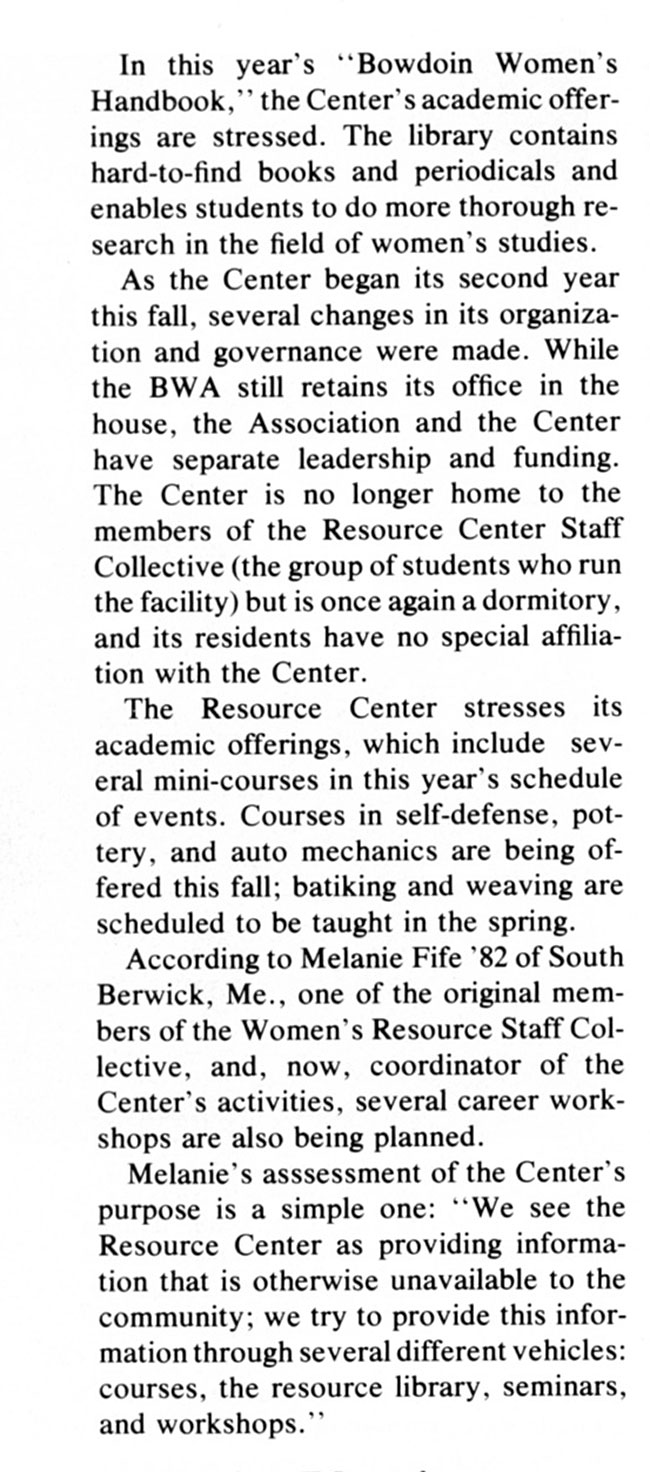
This piece highlights the Women’s Resource Center’s attempts to provide students with educational opportunities not yet available at the college. The 300-volume library of books by or about women is described as a major advance in providing more women focused resources. Alternative academic offerings in: self-defense, pottery, auto mechanics, batiking, weaving, and career planning are also highlighted as ways in which the Women’s Resource Center was supporting and educating women.

The accompanying picture displays cheerful women sitting on the front stairs of the Women’s Resource Center. The caption informs readers that these are some of the founding members of the Women’s Resource Center Collective. These women, along with others, provided the fire behind the opening of the Women’s Resource Center, its informational and passionate publications, and its inspiring events. The smiles on these women’s faces look genuine. One imagines they took pride in securing for Bowdoin women a vibrant, supportive space on campus to call their own.
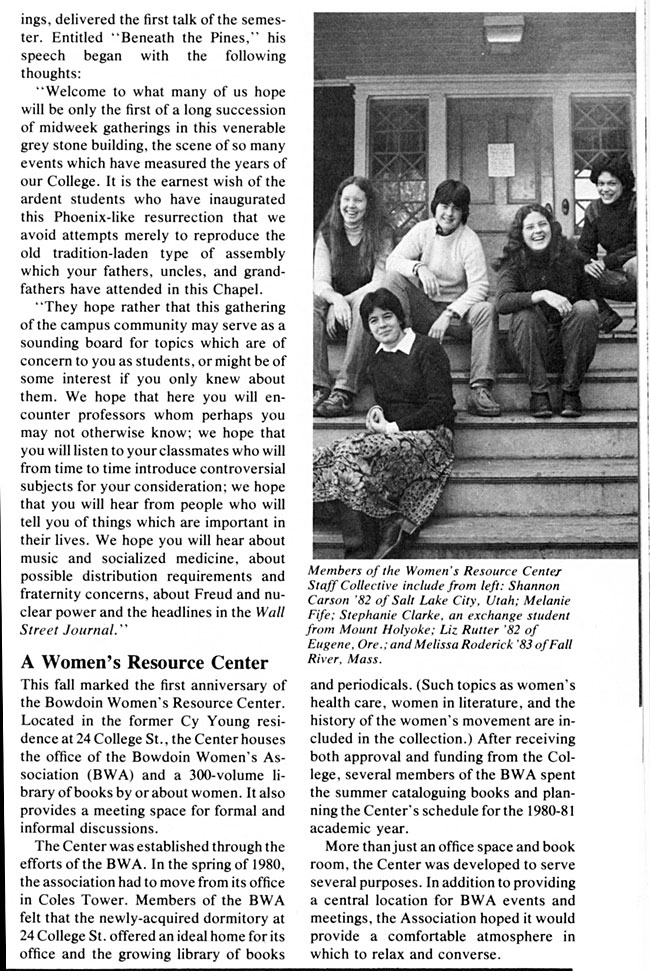
CS64 Page 1 - Bowdoin Alumnus Magazine: A Women's Resource Center
CS64 Page 2 - Bowdoin Alumnus Magazine: A Women's Resource Center

Filed Under: Documents, Women’s Resource Center Tagged With: 1981, Bowdoin Alumnus Magazine, CS64, Women’s Resource Center Collective

Holly Near at Bowdoin

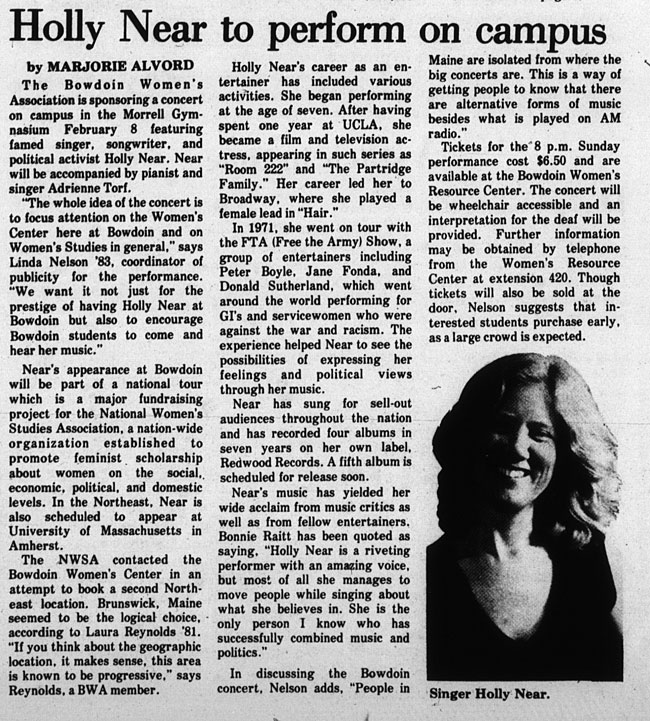
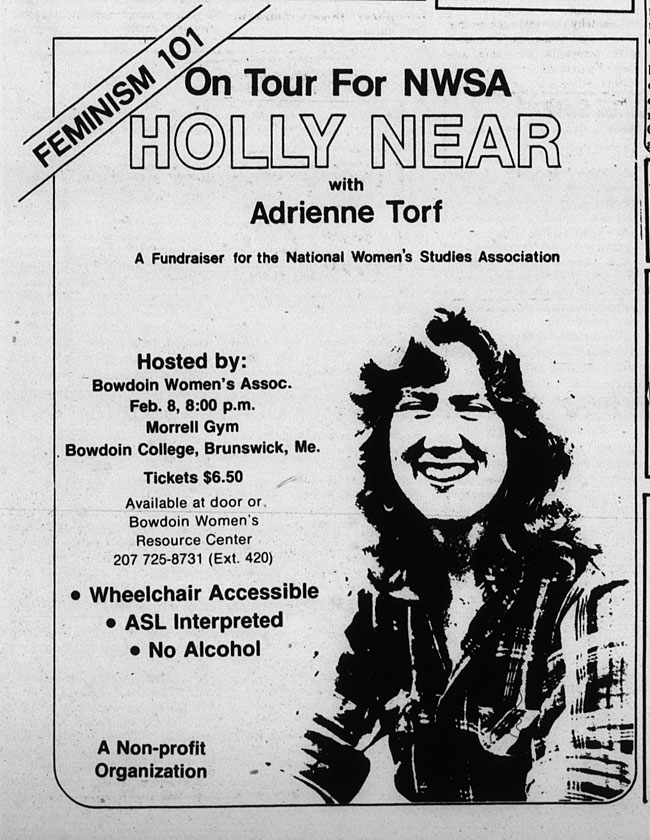
In March 1981, the Bowdoin Women’s Association brought singer, activist, and out- lesbian Holly Near to perform on campus (Document CS, 65).

“In 1972, Holly Near was one of the first women to create an independent record company… Near’s vision was to promote and produce music by politically conscious artists from around the world… Often cited as one of the founders of the “women’s music” movement, Holly not only led the way for outspoken women into the music world, but also worked for peace and multicultural consciousness.” ( http://www.hollynear.com/bio.html)

This concert provided an opportunity for women to come together, enjoy music and claim their space in the world and at Bowdoin. At this point, Bowdoin women officially had claimed Women’s Resource Center and were continuing to create more spaces for themselves on campus.

The women active in the Bowdoin Women’s Association and at the Women’s Resource Center were politically conscious, many of them were lesbians, and they fought for women’s rights at Bowdoin. Bringing Holly Near to campus was a way of claiming space, breaking down barriers, and demonstrating the strength on the feminist community.

Working with larger women’s organizations, such as the National Organization of Women, Bowdoin women were able to bring Holly Near to campus and to create a larger community and support network for themselves. Provision of sign language interpretation and wheelchair accessibility suggests that the organizers envisioned a truly inclusive community at the college.

Today numerous avenues exist through which to secure money to bring performers and lecturers to campus. A few years ago, Eve Ensler, author of The Vagina Monologues came to Bowdoin, and this fall singer and activist, Angelique Kidjo, brought to campus a vision of peace and justice through music. Guest performances continue to raise awareness and create new conversations around women’s issues at the college.

CS65.1 Orient 1981 february 6 - Holly Near at Bowdoin
CS65.2 Orient 1981 february 6 - Holly Near at Bowdoin

Filed Under: Documents, Women’s Resource Center Tagged With: 1981, Bowdoin Women's Association, CS65, Holly Near, Orient

Rethinking Sex

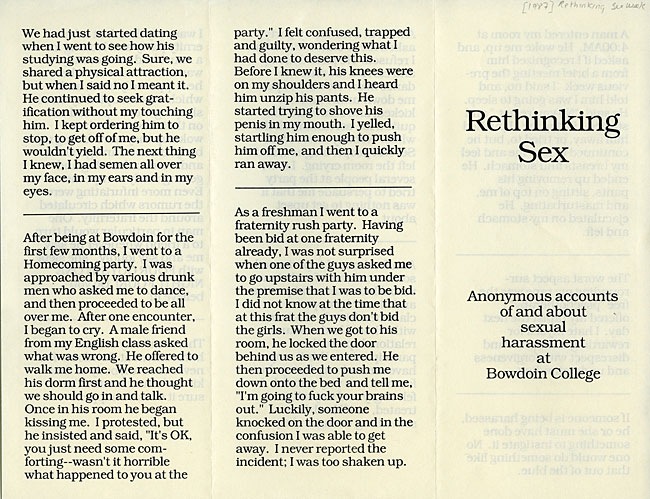
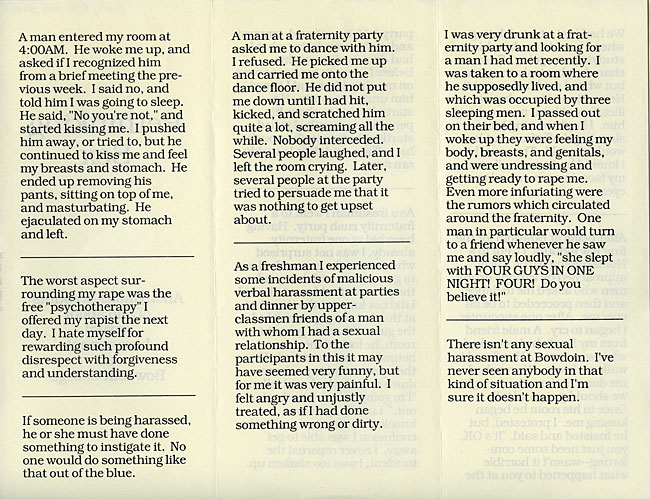
Rethinking Sex: Anonymous accounts of and about sexual harassment at Bowdoin College, is a collection of student stories and opinions from 1987 (Document CS, 66). One imagines that women wrote the majority of the stories, as most describe heterosexual encounters between men and women, with men as the aggressors. Part of Rethinking Sex Week, the publication accompanied an open forum.

By 1987, women had been at Bowdoin for over fifteen years and the Women’s Resource Center had been open for seven years. However, this may have been one of the first times issues of sexual harassment were addressed so publically. The safe environment of the Women’s Resource Center provided community and may well have raised consciousness sufficiently that women found the courage to share their stories publically albeit anonymously. The variety of stories in Rethinking Sex shows the differing and contradictory perspectives on sex in the Bowdoin community in the 1980s.

The means of educating Bowdoin students on issues of sexual harassment or sexual assault through sharing of anonymous personal stories remains an important part of life at Bowdoin today. In the fall of 2009, a new performance became an annual part of first-year orientation. Speak about it originated from stories in Speak, a more modern version of Rethinking Sex. Rethinking Sex may have started a trend in educating the Bowdoin community around these issues. Speak and Speak about it are also important elements of the Women’s Resource Center’s role on campus today.

CS66-1 - Rethinking Sex
CS66-2 - Rethinking Sex

Filed Under: Documents, Women’s Resource Center Tagged With: CS66, sexual harassment, Women's Resource Center

Orient: Bear Broads Bow

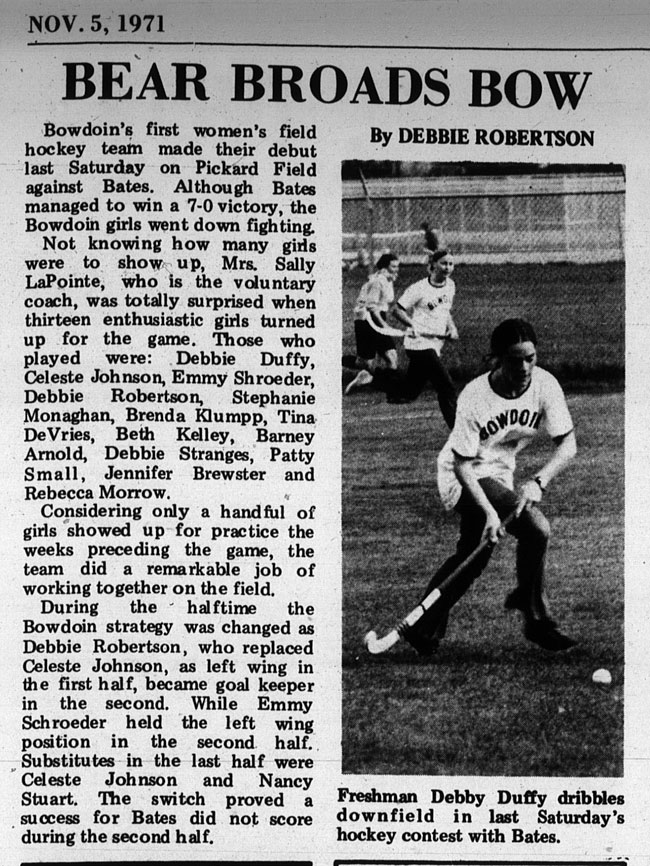
Bowdoin’s student newspaper, the Orient published this article by Debbie Robertson on November 5, 1971 (Document JH, 55), regarding the first game of the first women’s athletic team at Bowdoin—the field hockey team. Bowdoin played Bates at Pickard Field on October 30, 1971. Although Coach Sally LaPointe did not know how many student-athletes would show up to the game beforehand, thirteen hard-working women came to participate. Despite the Polar Bears’ 7-0 loss, LaPointe demonstrated her knowledge as a coach and made halftime changes that benefitted, as Bates did not score during the second half. This example shows that the perseverance of Bowdoin’s women’s athletic teams has, by now, been carried on for decades.

JH55 - Orient: Bear Broads Bow
JH55 – Orient: Bear Broads Bow

Filed Under: Athletics, Documents Tagged With: 1971, Debbie Robertson, Field Hockey, JH55, Orient, Pickard Field, Sally LaPointe

Excerpt from the Report of the President’s Commission on Athletics

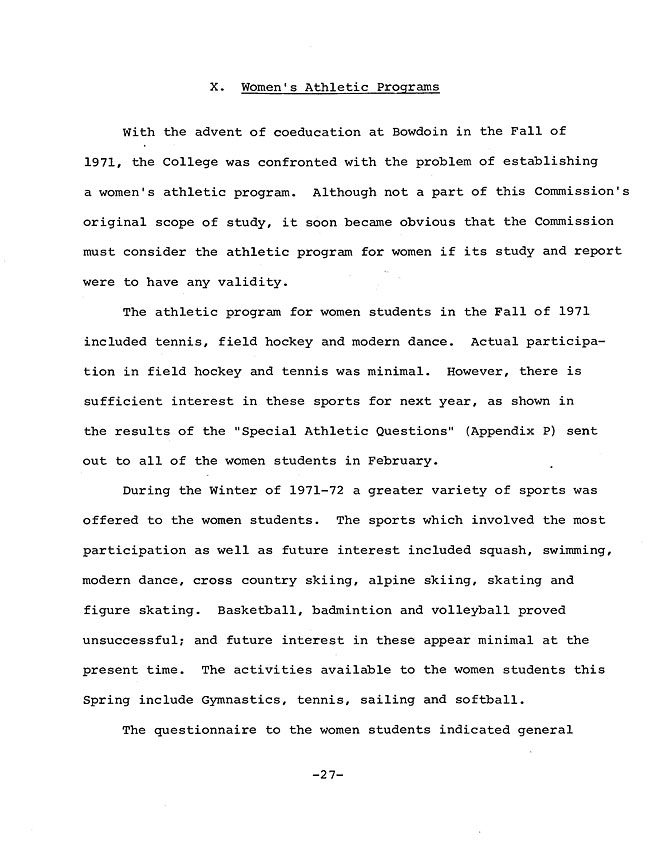
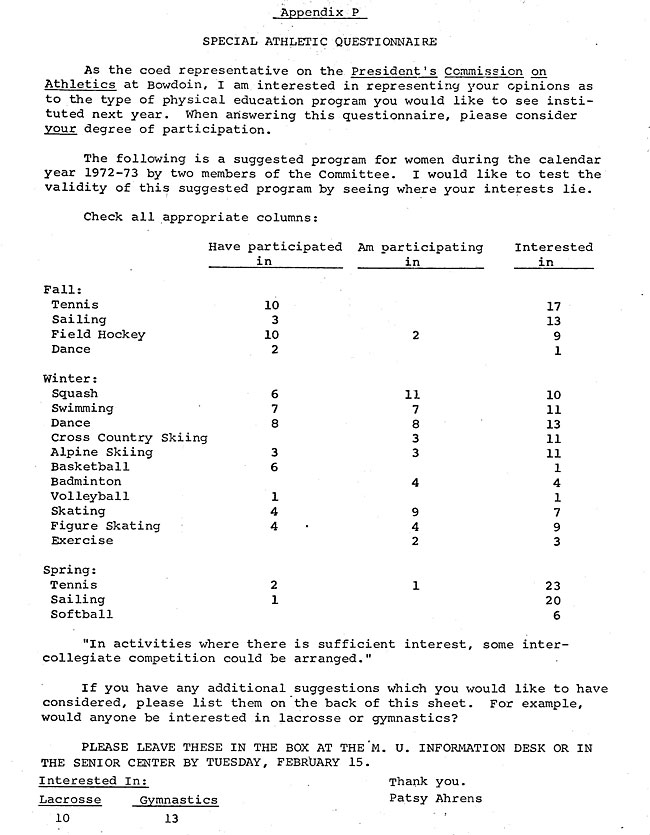
This document is an excerpt from the June 1, 1972 Report of the President’s Commission on Athletics (Document JH, 56), written by President Roger Howell, Jr., directly after the end of the first full year of coeducation at Bowdoin. The President notes the importance of investigating women’s athletics in order to for the report to “have any validity.” Because the first year of women’s athletics had displayed low numbers, the College gave a survey to women to determine their interest in physical activity. The survey indicated that women did want to participate in athletics.

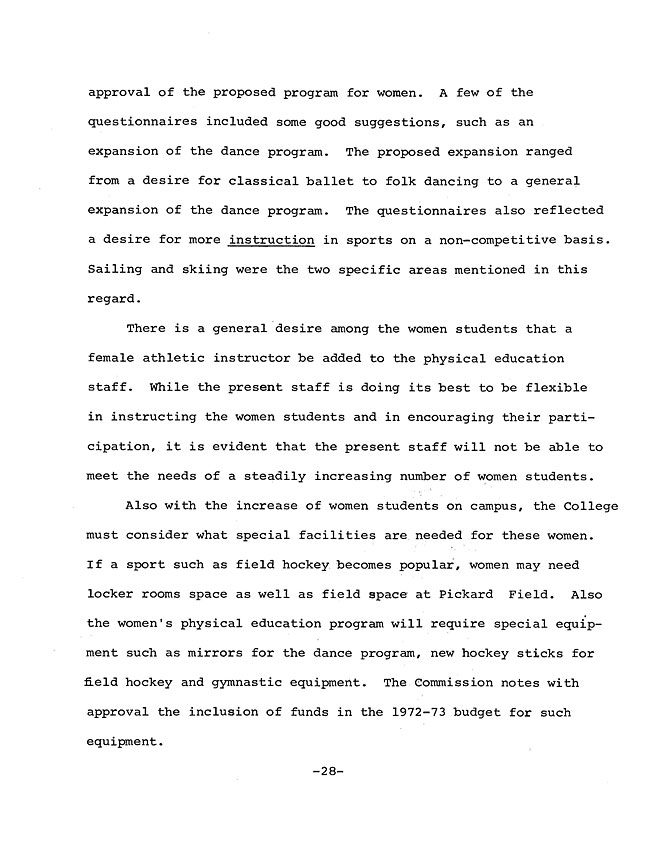
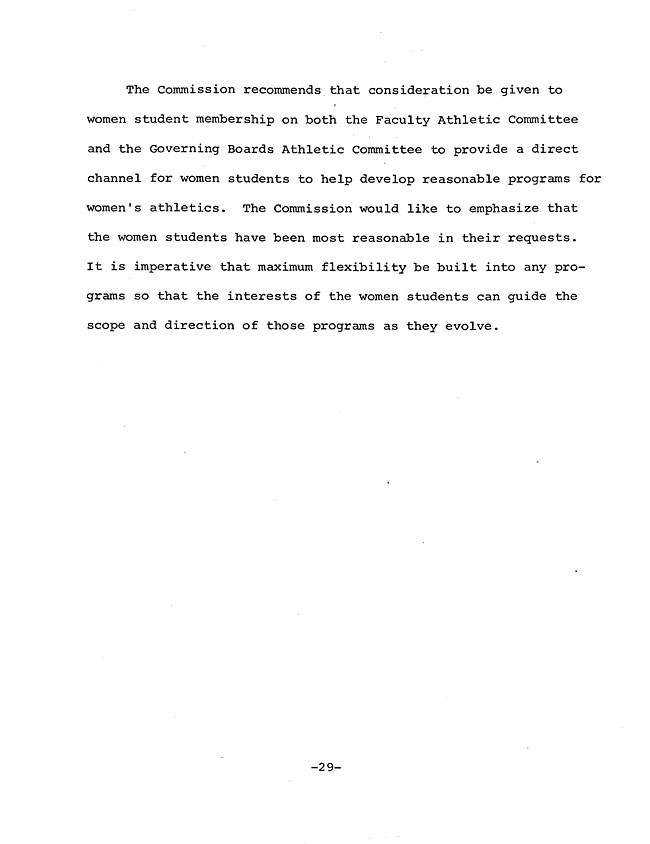
The President comments on the necessity for women to have not only mentors and teachers who were of the same gender, but also their own areas on campus such as locker rooms, field space, and their own equipment. Howell writes, “The Commission notes with approval the inclusion of funds in the 1972-73 budget for such equipment.” He also acknowledges that Bowdoin women need a voice on campus in groups that had a say in athletics. President Howell concludes by stating the importance of providing female athletes with the opportunity for and resources to shape their own program in ways conducive to them, not merely to men, and not to the administration.

JH56 Page 1 - Excerpt from the Report of the President's Commission on Athletics
JH56 Page 2 - Excerpt from the Report of the President's Commission on Athletics
JH56 Page 3 - Excerpt from the Report of the President's Commission on Athletics
JH56 Page 4 - Excerpt from the Report of the President's Commission on Athletics

Filed Under: Athletics, Documents Tagged With: 1972, JH56, President Howell

  • « Previous Page
  • 1
  • 2
  • 3
  • 4
  • 5
  • 6
  • …
  • 17
  • Next Page »

Categories

  • Athletics (9)
    • Documents (6)
    • Focus Group (1)
    • Oral History Interview (2)
  • Curriculum (8)
    • Documents (6)
    • Focus Group (1)
    • Oral History Interview (1)
  • Extracurriculars (10)
    • Documents (6)
    • Oral History Interview (3)
  • Prehistory (20)
    • Documents (18)
    • Oral History Interview (2)
  • Process (22)
    • Documents (12)
    • Focus Group (3)
    • Oral History Interview (7)
  • Social Life & Fraternities (20)
    • Documents (12)
    • Focus Group (3)
    • Oral History Interview (5)
  • Women’s Resource Center (8)
    • Documents (6)
    • Focus Group (1)
    • Oral History Interview (1)
  • Sources
  • Acknowledgments

Copyright © 2026 · research.bowdoin.edu · Powered by WordPress