Work Today (1/13/07) included…

just a few short hours on my improvements to this horizontal/perpendicular to the horizon vision scanning system.


horizon vision testing, originally uploaded by northern_bites.

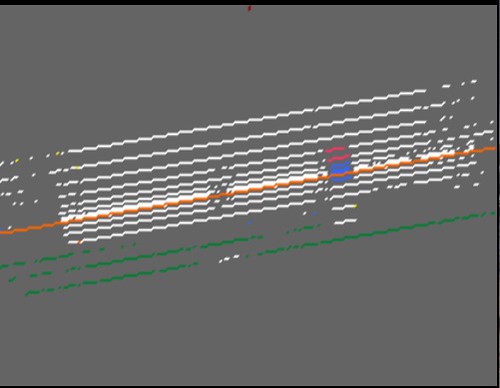
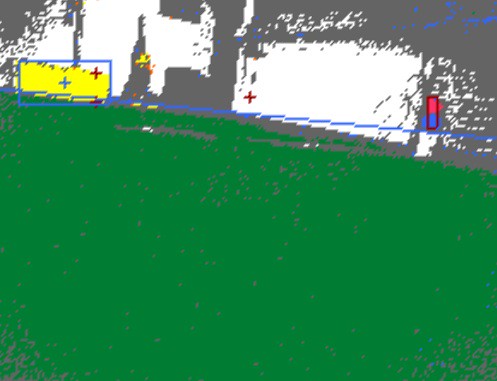
The photo is a first attempt at a post scanning algorithm that starts at the horizon line and then goes upwards and downwards in decreasing frequency scanning parallel to the horizon.

Next up is to give a run structure another go that stores important colors.

The added bonuses of this system are:

1) it fixes the disproportions that show up when you move the head around, thus making the scan lines perpendicular to the ground
2) it scans a lot fewer pixels, hence making the whole vision system much faster

I’m going to see if I can’t get more out of this system this week as I’ll have little to do other than work on vision while the Lab is under construction.

Work Today (1/12/07) included…

Re-read and cleaned up a lot of our vision code. My basic plan is to over the next few days try to make some substantial vision improvements in two particular areas: speed optimization and horizon line utilization.

All night I’ve been working on a scanning routine that only scans parallel and perpendicular to the horizon line. The math is a bit complicated, but as I’ve worked most of it out it seems doable but time consuming. I’m doing most of the code out to see if this has better advantages over a blob rotation method. We’ll find out.

Our Blog Pages Look Better

So the Media, Contact, and Team Info pages on this blog have all gotten a brief facelift.

Media no longer says ‘In Progress’ and I included a link to our YouTube video page there, of which I’ll promise to finally get some of the full games up in the next couple of weeks.

The Contact page — actually, I didn’t update that page at all. Sorry.

Team Info includes the new 06/07 Northern Bites members + a few formatting updates.

Work Today (1/11/07) included…

Some New Goal work and some Horizon work.

First, I tried to debug and integrate Joho’s work on recognizing the new goals. I’ve narrowed down the buggy code, but couldn’t fix it. So hopefully more luck with that when Joho can take a closer look at it.

Second, I actually used the Horizon line calculation for some good. The purpose of the horizon line is basically twofold: it gives you an idea of where to look for things and it gives you an idea of where not to look for things. This seems simple but the GermanTeam‘s report helped me clarify this a bit.

Most important objects more frequently appear around the horizon: goals, posts, far-away balls, etc. Close objects included really close goals, close balls, dogs, and lines. The former are also by nature further away from you and are therefore take up less room in the image. The horizon line gives you a good idea of where to scan intently. Beneath the horizon line you can scan sparsely. Above the horizon line–heavens to betsy–you don’t really have to scan at all.

This last bit was clear to me from the beginning. Scan less above the horizon line and you’ll cut down on false positives and speed up the vision system simply because it has fewer pixels to process. But giving you a better idea of where to scan more fervently, however, now that’s an idea that deserves some good coding.

Aibo Likes Distance Estimation

With a new fix of pose transforms last night, here are some new pose estimated distances of the ball to the center of the body, using nothing but the position of the body and the position of the ball on the screen (plus the known height of the ball):

Actual: 30 Reported: 32
Actual: 50 Reported: 49
Actual: 70 Reported: 69
Actual: 90 Reported: 92
Actual: 110 Reported: 113

As you can see, I am a genius. A few notes though: the estimates get noisier as ball gets further away. This is to be expected: variations in the angle from the focal point (camera point) to the ball xyz space gets narrower, hence the noise has a greater effect on the distance estimation. Now to check the distances at various head angles

Work yesterday (1/8/07) included…

lots more Vision profiling. For my parents’ information, that means that I found out what specific parts of the vision system slow the Aibo down. For the Aibo, ‘slow’ means that it can process less information in a second, or another way of putting it is that its reaction time degrades. Ideally, the Aibo will make decisions at about 30 times a second. Currently, with a bunch of stuff that we’ve been adding and some bottlenecks we’ve only just discovered, it’s down to about 23-25 frames per second (fps).

Moving onto more complicated things for fellow nBiters: over 50% of the average vision frame is taken up by chromatic distortion filtering. I know, it seems pretty ridiculous to me as well. About 25% percent of a vision frame is just thresholding, 7% is for line recognition, and then the rest is basically python processes including the EKF. Check the Wiki for more details.

Anyways, here are the areas for optimization:
-Chromatic Distortion (duh). We may be seriously screwing something up.
-Thresholding (duh). There may be more we can do here, either by reducing the size of the LUT or memory-wise.
-Python Overhead — see the tests on Trac, but I believe we’re losing about 3-4 fps just on creating python objects from c objects, a project ripe for Jeremy’s attention.

In other news, I found another huge bug in our body transforms just a few minutes ago: turns out I was doing body rotations in the wrong order (apparently matrix multiplication order matters, who knew?) and it took me re-reading and re-reading the German, Ozzie, and Texan papers to figure the proper order out. The focal point estimates look a lot better now in cortex and so I’ll be testing distance estimates tomorrow.

Next up: finally figuring out the pose-estimated horizon line swiftly followed by blob rotation fun. Fun.