GermanOpen 2007: Call for Pre-Registration

Just announced today: The GermanOpen 2007 will be held in Hannover over April 16-21. Apparently the event will be held in ‘the world’s largest industrial fair’. That’s pretty cool. The event will be hosting lots of other leagues beyond our own, and I found this little note particularly interesting:

The RoboCupJunior competition in Hannover is restricted to German teams. They have to qualify for participation in the RoboCup German Open in regional events held in Magdeburg (February, 23rd-25th) and Vöhringen (March, 2nd-4th). Details and a call for participation for these qualifying events will be issued separately.

They are serious about their RoboCupJunior in Germany. And I’m not a hater at all–RoboCupJunior was the sole reason I stayed sane throughout the entire RoboCup 2006. Especially the Dancing.

UPDATE::
link above re-linked to English version, linked in the Links section to your right as well.
robocup.bowdoin.edu having issues

varied reports suggest that robocup.bowdoin.edu is inaccessible from the bowdoin wireless network: in the lab, in seth glickman’s room, and possible elsewhere. Yes, this means that the blog, and svn, trac, etc.

Just plug an ethernet cord in as a temporary measure.

I put this note in the blog to get Jeremy to put his thanksgiving laziness behind him and fix this bug.

UPDATE:: though Jeremy and I spent an hour debugging this, we later found this email from IT:

From: [email protected]
To: [email protected]
Date: Tue, 28 Nov 2006 18:33:28 -0500
Subject: wireless connectivity issue
We are currently experiencing problems with the wireless network and logging into Bowdoin web services (Blackboard). Until this is resolved please connect to the network using an Ethernet cable.

Thank you,

Information Technology

Let me know if anyone gets another saying that it’s working now. That would be useful.

UPDATE::Problem seems to be fixed in the lab. Anyone else having issues?

Some Line Success

.flickr-photo { border: solid 2px #000000; }
.flickr-yourcomment { }
.flickr-frame { text-align: left; padding: 3px; }
.flickr-caption { font-size: 0.8em; margin-top: 0px; }

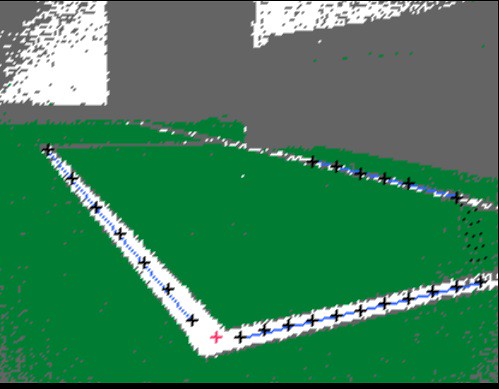
So I feel like I’ve gotten line “detection” and line “formation” to good places. Sadly that pink dot that looks like recognition of a corner joint is actually just an outlier. Landmark detection is the next chore: now that we have bunches of lines, how to figure out if these lines make a corner? And which corner? Oh, plenty more work to do.

Line Work

So the the real focus of our team right now is localization: teaching the dog to know where it is on the field. A critical part of localization is a decent Vision system: having the dog to correctly identify landmarks. We’re pretty good at identifying big things like the posts and goals (though the new goals are giving us issue), but we’re pretty lousy at detecting line intersections on the field.

Here are the various issues plaguing our line recognition:
* Thresholding. The way we threshold–identifying RoboCup colors from the millions of colors that show up on the Aibo’s camera–heavily relies on segmentation. I don’t have time to explain segmentation, but let’s just say that it’s great for every kind of color object except for really small white sections that make up the lines.
* Landmark Detection. We can identify line as individual segments with some success–we can’t identify when they intersect. That is to say we can recognize two lines on the screen, but can’t recognize that they form a corner of the field. This should be one of the easier tasks.
* The lines and center circle in the lab. The physical lines on our Lab’s field are pretty yellowish (made from masking tape) and the center circle isn’t actually a circle. You have to stand way back to mistake it for a circle. It’s instead just a circle-ish grouping of line segments.
* The camera settings. We are forced to use the most blurry settings — which make the field brighter — because the lighting in our lab is so dim. Our lighting upgrade may still be months away.
* We don’t have a PS3 or even a Wii.

Chromatic Distortion Gone Awry.

This is what happens when you run the chromatic distortion filter on an image recursively about a thousand times… crazy effect, huh?

What’s scientifically going on here is that we’re trying to ‘correct’ distortions in the picture that happen increasingly as you move away from the center of the image. Therefore, the center of the image is really good, and the corners are really bad. This filter ‘corrects’ those bad pixels by comparing them to the center pixels and approximating new values for them.

This is what happens when you run the filter on an initial image, then run it again on the filtered image, then run it again on the filtered, filtered image, etc (ie, recursively).