The Nao is finally here!!

.flickr-photo { border: solid 2px #000000; }
.flickr-yourcomment { }
.flickr-frame { text-align: left; padding: 3px; }
.flickr-caption { font-size: 0.8em; margin-top: 0px; }


IMG_1290, originally uploaded by northern_bites.

Our first Nao came today. We are currently looking through the documentation and waiting for the battery to charge. We will post more video and other updates once we figure out how to turn it on :).
Check out the flickr set with the unboxing pics.

Our first Nao is on the FedEx truck for delivery!

After an announcement yesterday that Aldebaran finally sent the first of our Nao, we got a tracking number this morning which shows the yet unnamed robot’s journey through Paris, Newark and then finally Portland. This morning at 7 am it was put on a truck for delivery, so it should make here by tonight! Stay tuned for unboxing pics and more coverage.

Quadruped robot walks 5.6 miles

See here:

Not quite bipedal, but pretty cool. In particular the article notes that

The event … was to show off the machine’s energy efficiency. Unlike other walking robots that use motors to control every movement, the Ranger emulates human walking, using gravity to help swing its legs forward.

Standing still, the robot looks a bit like a tall sawhorse; walking, it suggests a human on crutches, alternately swinging forward two outside legs and then two inside ones. There are no knees, but at the ends of the legs are feet that can be tipped up and down, so that the robot pushes off with its toes, then tilts its feet upward to land on the heels as it brings its legs forward.

Robotstadium: Online Nao simulation league

Gostai, Cyberotics and Aldebaran have announced Robostadium, which is an online simmulation league based on the rules for the Nao SPL . The league is open to anyone, and the winner gets a free Nao and a software pack with URBI and Webots PRO. I think this will be really cool, since it could draw a ton of outside interest to our league.

I’d heard about this idea a while ago, and I was worried that only the established RoboCup teams would have a fighting chance, since walking is so difficult, but now I think there won’t be any or at least very few RoboCup teams participating:

The competitors will have to program a team of 4 Nao robots using the URBI middleware and the Java programming language.

Since most teams have considerable code infrastructure of their own in laguages like C++, and Python, porting this code to Java and learning a proprietary language like URBI is going to be a huge barrier to entry. (Especially considering that Nao teams already have a ton of work on their plates getting a new code base running). I’d have loved to participate, and we probably would have had a decent shot at winning the prize, but the potential reward isn’t really only worth it since code on the actual Nao can’t interoperate easily with the code in the Webots competition. (Since the Gyros aren’t simulated in Webots anyway, having a good walk engine in the simulator would have been difficult regardless of the requirement to use URBI.)

From a business side, this move to make it more difficult for RoboCup teams to enter is probably smart. Alderbaran is already getting money from all the RoboCup teams, so broadening their markets is probably a good thing. (i.e. It would be discouraging for new comers to get beat by all the RoboCup teams who have been doing this for longer.) Also, it hardly makes sense for Gostai to support behavioral scripting in Python or other languages like C++ (with can run a Python interpreter), since Gostai makes a living off people using their product to exactly those things.

I’m also interested to see how the rules and refereeing is going to work in the online simulation. The current world is pretty good, but out-of-bounds detection needs some work, and there is no replacement for a game-controller, as of yet. Without human-refereeing, it could become really tricky to assign pushing penalties, obstruction penalties, and most importantly ban goals scored from the center circle.

C++ programming woes

It took me hours and hours to find this bug today. The following code works (even though in my opinion it shouldn’t). The code is more pseudo- than real. The real thing wouldn’t be understandable anyway.


Matrix *m1 = (Matrix*)malloc(sizeof(Matrix));
free(m1);
useMatrix(m1);

The code did exactly what it was supposed to do even though I free up the memory in between the calls in a more complicated scenario. However, when I modified the code to this


Matrix *m1 = (Matrix*)malloc(sizeof(Matrix));
free(m1);
Matrix *m2 = (Matrix*)malloc(sizeof(Matrix));
useMatrix(m1);

I got a segfault and couldn’t figure out why creating a new object would cause my program to crash. In my opinion a more sensible scenario would be that the first code snippet would cause the program to segfault, so I knew that there was something wrong already.

Bizzare… The platform is OS X Leopard with gcc 4.0.1. The current theory is that even though I free the memory, the contents are still intact and the OS is able to use them, but once I malloc again, the same region of memory got overwritten and the old pointer was marked invalid. I don’t know…

Anyone who comes across this and has a good way of explaining this awful behavior to me, I would be happy to hear it.

The Naos are coming soon!

Last week we got word that the parts for the first batch of Nao had arrived in Paris, and that we would be getting our first two robots soon. Manuela Veloso from CMU went to visit the Aldebaran plant in Paris, and was apparently impressed with the Nao she saw. Check out the video here .

I was surprised that the robots are being assembled in France – I was expecting them to come ready-made from China or Taiwan like every other piece of electronics I know. Hopefully this means they will be higher quality, so long as no one forgets to plug in the cable to the camera or something! Also, the German Team has discovered from the video that the simulator prototype and the real robot have a different joint order in the legs relative to the Webots prototype, so probably there will be other discrepancies we’ll need to tackle once we get them.

On Friday we got the billing request, so hopefully that means once they get the money they’ll ship us ours! We could get them as soon as next week, which would give us 8 weeks of prep time for the demo at the US OPEN on the 24th of May. Eight weeks should be enough to tune our walk to work on the real robot, and to implement some simple soccer behaviors, so we could see some real soccer at the demonstration!

Edit: We have received word that the Nao are to ship on Monday, March 31.

Webots 5.8 released with new field, new goals and better performance

.flickr-photo { border: solid 2px #000000; }
.flickr-yourcomment { }
.flickr-frame { text-align: left; padding: 3px; }
.flickr-caption { font-size: 0.8em; margin-top: 0px; }

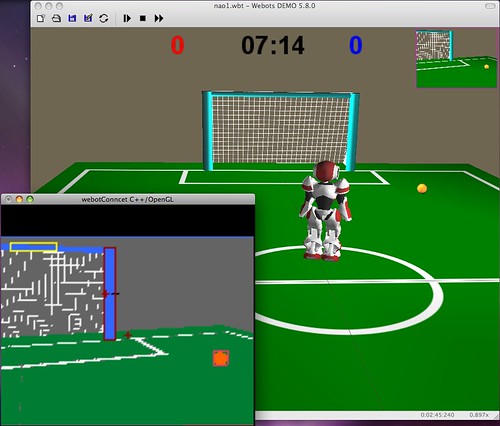
We installed Webots 5.8 today, which has included the changes from the new Nao rules. Beacons have been eliminated, the goals are much bigger, and the field size grew slightly. Why no one announced this release is puzzling, but it was only released about 10 days ago, so maybe they haven’t had the chance.

This version of Webots also has the Nao contest setup, which we hear rumors of starting any day now. Allegedly, the winner of the online contest will receive a Nao, and a PRO license of Webots. Though I can’t see any non-RoboCup team winning the competition, since it takes a lot of infrastructure development to make a successful team.

We’ve tested our vision algorithms on the new goal size, and they seem to be working great. Also, the new verison seems to be running faster than before on our Mac Pro, even though Webots refuses to take advantage of the multiple cores to do it’s physics processing.

Nao turn-in-place demo

After a breakthrough in robot motion technology, our nao’s can turn in place at an astounding rate of 16 degrees-per-second. The aibos probably turn at least 10 times that fast. Eventually we will run machine learning on the gait to get a faster one, but this one is pretty good.

The key to having a stable turn is to be able to widen the angle between the legs and take one step with wide legs, and then a step which restores them to normal. The only joint on the Nao which can widen this angle is the HipYawPitch, so you need to compensate for it’s use with the other Hip joints.

See the video here.

More Development Stats

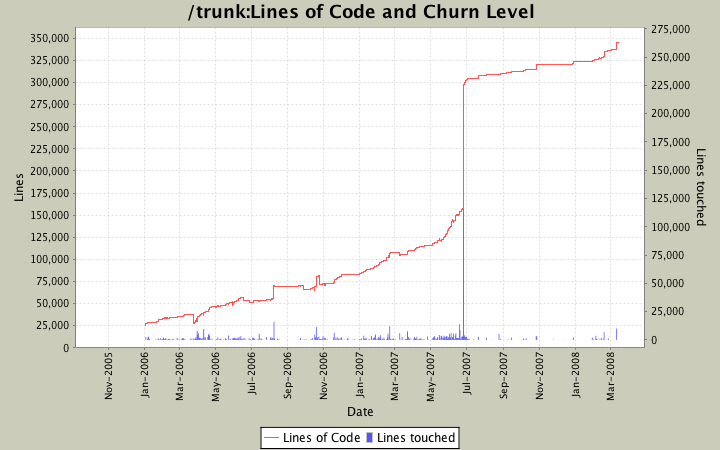
Joho’s post from a little while ago about commits and code changes in SVN got me interested. So today when I came across a very cool and very extensive utility appropriately called StatSVN I immediately downloaded a copy of the code. Running it on the trunk took quite a bit of time and ultimately outputted over 480 html and png files, to make a nifty web page on my box. I’ve put some of the files up and I’ll be looking at maybe setting up some of the information for view here on the site.

Here was my favorite picture (with a close second going to the fact that our lowest amount of code change comes around lunch time).

LOC and Churn

LOC [Lines of Code] and Churn shows the usual LOC with the amount of code touched per day. Hopefully this should go decreasingly towards a release.